Pages

Showing posts with label mysteries. Show all posts

Friday, June 23, 2023

The Anatomist's Widow

I encountered the Lady Darby novels through a circuitous path of Amazon recommendations—mostly in connection with other series I have covered in New Books Network interviews. Specifically, my interest in
C. S. Harris’s Sebastian St. Cyr books and Jacqueline Winspear’s Maisie Dobbs novels led to
Anna Lee Huber’s Lady Darby and Verity Kent novels. At first, I wasn’t sure that I wanted to commit to another series, never mind two, but I kept coming back to them and eventually decided to give them a try.

What drew me to the Lady Darby books in particular was their setting, which is a little off the beaten path. Most of them take place in Scotland during the 1830s. The Regency has ended—in fact, George IV has died, leaving his brother William as king—but the Victorian era has yet to begin. Familiar figures—the Duke of Wellington, Lord Melbourne, and so on—make their appearance, but the contexts are different. And the contrast between rich and poor, as well as the harsh restrictions placed on society ladies, inspire important elements of each plot.

When we meet the series heroine—Kiera, Lady Darby—in The Anatomist’s Wife, she is a young widow in her mid-twenties. A gifted portrait painter, she is in a state of emotional near-collapse caused by the abuse she endured during her three-year marriage and the even more traumatic investigation that followed her husband’s death. A social outcast, she has taken refuge in her brother-in-law’s castle, but a house party arranged by her sister reawakens all of Kiera’s fears. When one of the guests turns up dead, she is the prime suspect. To clear her name, she agrees to assist Sebastian Gage, another guest and a semi-official  inquiry agent, to find the suspect. Gage is, to put it mildly, not Kiera’s type: a self-assured, relentlessly flirtatious gentleman who employs all the social skills that Kiera so noticeably lacks in pursuit of his goals.

Fast forward two years, when A Fatal Illusion opens, and a great deal has changed. Over the course of ten cases, Gage and Kiera’s partnership has become firmly established. So when Gage’s arrogant, disobliging father is attacked in Yorkshire, the pair of them set off to find out what happened and to provide whatever aid they can.

Somewhere along the way—perhaps around book 6, A Brush with Shadows—I realized that, thanks to my connection with the New Books Network, I could sidestep Amazon’s unending pleas that I pre-order the latest book and go straight to the publisher. As a result, I had the chance to interview Anna Lee Huber  about the entire series toward the end of last month. The interview went online this week, though, to coincide with the book’s release on June 20, and you now have the chance to listen to our conversation. Read on to find out more.

As usual, the rest of this post comes from New Books in Historical Fiction.


This—the eleventh installment in Anna Lee Huber’s Lady Darby Mysteries featuring Kiera and Sebastian Gage—opens in Yorkshire in 1832. The two of them have come a long way since their first acrimonious meeting two years earlier; in fact, they have married and produced an infant daughter. Yet Kiera, Lady Darby, is still known by her detested first husband’s title—a courtesy extended by society that she would much rather forgo in favor of being plain Mrs. Gage.

On this occasion, Gage has received word that his father has been attacked and left for dead on the Great North Road. Despite years of neglect and mistreatment, Gage rushes to his father’s side, bringing his family with him. After discovering his father alive, if not well, Gage and Kiera set out to discover who attacked him and why, but they have to contend with both the victim’s refusal to share all he knows and resistance from the locals, who are determined to protect a group of highwaymen (or is it a group of smugglers?) whom they believe to be the nineteenth-century equivalent of Robin Hood.

As always in these mysteries, the setting comes vividly to life, the problems unknot themselves in satisfying but not always predictable ways, and the characters slowly move toward greater understanding of themselves and others. If you haven’t encountered Kiera and Gage before, you should certainly seek out their adventures. But do yourself a favor and start with book 1, The Anatomist’s Wife. Although you can tackle the books in any order, you will enjoy them more if you read them as I did, from start to finish.

As I noted last week, because of changes to Wix, which hosts my main author website, and my own desire to consolidate my author persona in one secure location, I will be transferring my blog to my main site, https://www.cplesley.com, at the end of June 2023. The older posts—dating from June 2012!—will continue to be archived here for as long as I can make that happen.


Friday, June 9, 2023

Reimagining Tragedy

I encountered Katharine Beutner’s new novel, Killingly, through a NetGalley recommendation and was instantly hooked. I graduated from Mount Holyoke College, and although that was a long time ago now, I still have fond memories of South Hadley and its environs. But I had never heard of this case of a missing student, either when I lived on the campus or in the years since. Fortunately, the author agreed to speak with me for a New Books Network interview, which posted just this week, around the time of the book’s release.

To be clear, this novel draws on a historical event, and some of the characters and details are also historical. But the book itself is, as advertised, a psychological thriller that includes fictional characters and a lot of (fascinating) speculation about what happened to Bertha Mellish, the missing student, and what might have been going on in her family that precipitated the story events. Read on—and, of course, listen—to find out more


As always, the rest of this post comes from New Books in Historical Fiction.

In 1897, a Mount Holyoke College junior named Bertha Mellish disappears from campus overnight, leaving no word for her family. It’s a time when female college students are still considered “queer” (in the old sense of peculiar as well as the modern understanding of the word), although the college administrators insist that their primary purpose is to produce excellent wives and mothers. But even this community of oddities considers Bertha strange, by which the other girls mean that she pays too little attention to parties and boys, too much to her schoolwork and social causes.
 
Bertha’s only true friend is Agnes Sullivan, a young woman from a poor Boston family who has been forced to conceal her Catholic upbringing to gain admission to the college. Agnes, a would-be doctor (an even greater anomaly in late 19th-century culture than a woman with a college education, although not inconceivable), grieves Bertha’s absence but insists she has no idea where Bertha might be. Dragging the rivers and lakes turns up nothing, supposed sightings of the missing girl lead nowhere, and the police would be willing to write the case off as closed if only her relatives and the family doctor would let it go.

Almost from the beginning, it’s clear that Agnes knows far more than she lets on, but finding out what really happened to Bertha and why is a long, winding trail of suspense. Through the overlapping stories of Agnes, Bertha’s sister Florence, Dr. Henry Hammond, and the inspector whom Hammond hires to find the missing girl, Katharine Beutner keeps us on the edge of our seats as she unravels their tangle of secrets and lies. Perhaps the most intriguing element is knowing that however fictional the plot and many of the characters, the story derives from the real-life disappearance of a Mount Holyoke student in 1897, the mystery of which has never been solved.

Image of Mount Holyoke College’s Seminary Hall in 1886 public domain via Wikimedia Commons.

Friday, May 26, 2023

Interview with Alison Goodman

Like Alison Goodman, as she notes below, I first encountered Regency London through the novels of Georgette Heyer, which I discovered in my early teens. Even now, I go back to my favorites every so often, although as I have matured, so have my views on which stories I consider favorites.

Heyer wrote her first novel at eighteen, and her early heroines were teenagers. Over the course of her long life, the heroines aged into their twenties, but women over thirty remained bit players—chaperones, governesses, and, worst of all, poor relations, doomed by the dreaded word “spinster” to secondary status even in their own families. So to encounter Alison Goodman’s 40-something unmarried twins—Lady Augusta Colebrook and her sister, Lady Julia—is a pleasant surprise. That the two women, each in her own distinctive way, resist the society that would relegate them to back rooms and lace caps just adds to the fun. And then there’s the disgraced Lord Evan Belford, escaped convict and highwayman, a charmer in his own right.

Alison Goodman was kind enough to answer my questions, so read on to find out more, then seek out The Benevolent Society of Ill-Mannered Ladies when it comes out on Tuesday. You won’t be disappointed. In fact, I can’t help thinking that if Heyer were writing today instead of in the last century, this is exactly the kind of story she would produce.

Your previous novels cover quite a range, from contemporary mystery to fantasy—including the Dark Days Club series, which might be considered Regency historical fantasy. How did this path lead you to The Benevolent Society of Ill-Mannered Ladies?

It has been quite a winding path through many genres to The Benevolent Society of Ill-Mannered Ladies. I suppose it is because I love to challenge myself when I write, and part of that is to write in different genres or to mash them together in ways that I hope will create surprise and delight. I would say the path to The Ill-Mannered Ladies started when I was twelve years old and my mother gave me my first Georgette Heyer historical novel. I immediately fell in love with historical fiction, and particularly books set in the Regency era. So, that love of all things Regency has been sitting in me for a long time. It first showed itself in my Dark Days Club series, which is like Pride and Prejudice meets Buffy, and is now in full throttle with The Ill-Mannered Ladies. The Ill-Mannered Ladies has no fantastical element like the Dark Days Club series, but it is as historically authentic and accurate as that earlier series and has as much action, romance and adventure. Plus it’s funny.


Lady Augusta Colebrook is quite a character. Tell us a bit about her.

Lady Augusta, or Gus as she is known to her twin sister Julia, is the main character and narrator of The Benevolent Society of Ill-Mannered Ladies. She is 42 years old, unmarried, smart, and a wee bit snarky. She is bored by the high society life she leads and is looking for purpose in her life beyond what society says a woman of her age and rank is allowed to do. And so, the Benevolent Society of Ill-Mannered Ladies is born—Gus and her sister decide to use their privilege and invisibility as “old maids” to help other women in peril.

Her sister Julia is quieter and more biddable, yet she always seems to come through in a pinch. How would you describe her?

Julia is, I think, very much the “middle” child. She is the peacemaker between her fiery older twin, Gus, and their younger brother Lord Duffield or Duffy, as his family calls him. Julia seeks harmony and peace in her life, but that does not mean she won’t answer the call to adventure. She has a grounded serenity, and if Gus is ever in any trouble, Julia will come out swinging on her twin’s behalf. She has a lot of quiet gumption.


The twins, like many twins, have a special bond. Among other things, they often communicate without words. Why did you include that element?

I love the idea of a secret language between twins, which has been well documented in real twins, and it provides a lot of fun in the book. Gus and Julia communicate through their expressions: a flick of an eyebrow, a frown, a particular smile. Their secret language gives them an advantage in both social situations and on their adventures, and it really adds to their closeness as sisters in the novel.

Do introduce us to Lord Evan Belford. He is an absolute delight.


Ah, Lord Evan. What a honey! He’s had a bit of rough time of it: fought a duel twenty years earlier as a young man and apparently killed his man so was charged with murder, found guilty, and transported to Australia. Now he’s back in England for his own reasons and happens across Gus and Julia on one of their adventures. And when I say “happens across,” I mean he attempts to hold up their coach and Gus accidentally shoots him. However, he is exceptionally forgiving and so starts a wonderful partnership. His circumstances have forced him to live outside the privilege of his upbringing as the son of a marquess and so he is a rather appealing blend of gentleman and rogue.

In contrast, neither the twin’s brother, Lord Duffield, nor Evan’s, Lord Deele, could be considered at all delightful. Could you give us a brief description of them?

To be very brief, Duffy is Mr. Pompous! He is very much a man of his time—literally titled and very much entitled. Since their father’s death, he is the head of the Colebrook family and he believes it is his right to control his unmarried sisters’ lives. As you can imagine, that does not sit well with Gus at all. Lord Deele is Lord Evan’s younger brother but through circumstances has inherited the family title and wealth and is guardian to their younger sister. He, too, feels that as head of the family he can control the women within it, with disastrous consequences. Both of these characters are emblematic of the misogyny of the period but also have their own needs and goals that, unfortunately, get in Gus’s way. And woe betide anyone who gets in Lady Augusta Colebrook’s way!


Sketch for us, please, the cases that occupy Augusta and Julia in this book.

Without giving too much away, I have structured the novel into three cases (a nod to the wonderful Conan Doyle), each with its own story, but each also part of the overarching story. The first case takes Gus and Julia to a country house to save a wife in dire peril. The second takes them to Cheltenham and a nefarious situation in a brothel. And the third case takes them to a heinous asylum. I call the novel a serious romp, because it is fun and full adventure but also deals with some of the darker aspects of the Regency period.


This novel leaves Lady Augusta with an uncompleted mission. Are you working on the next book now, and can you give us any hints about what to expect?

I am, indeed, working on the next book and having as much fun with this one as I did while writing The Benevolent Society of Ill-Mannered Ladies. It’s another serious romp, this time with two longer cases rather than the three cases in the first book (yes, I’m having fun playing around with structure again!). Anything more, I think, would start to head into spoiler territory for the first book, so I will end by saying you can expect Gus and Julia to be just as resourceful, ill-mannered, and indomitable.

Thank you so much for answering my questions!


Alison Goodman is the award-winning author of eight novels—The Benevolent Society of Ill-Mannered Ladies,  the Dark Days Club trilogy, the fantasy duology EON and EONA, Singing the Dogstar Blues, and A New Kind of Death. She lives in Melbourne, Australia. Find out more about her at https://www.alisongoodman.com.au/.


Portrait of Alison Goodman © Tania Jovanovic. Images of Regency ladies, gentleman, and highwayman public domain via Wikimedia Commons.

Friday, April 21, 2023

Long Shadows

As anyone who read my written interview with C.S. Harris to celebrate last year’s release of When Blood Lies, the previous installment in this gritty historical mystery series set during the second half of the Napoleonic Wars, must realize, I am a hard-core fan of the Sebastian St. Cyr novels.

A large part of my enjoyment comes from following the maturation of Sebastian himself, as well as his relationships with various family members and love interests. But there are many other recurring characters—Hero Jarvis and her father; the actress Kat Boleyn; the Earl of Hendon, forever befuddled and somewhat appalled by the unconventional behavior of his heir; the Dowager Duchess of Claiborne; the pain-riddled surgeon Paul Gibson and, most recently, his live-in lover and fellow physician Alexi Sauvage—whose development I eagerly follow. So when I learned that another book in the series was in the works, I actively pursued the opportunity to feature the author on my New Books Network channel.

And the result was a wonderful conversation about how a young woman who set out to be an archaeologist wound up writing historical mysteries set in the 1810s. Read on—and most of all, listen—to find out more, including a hint as to what to expect from the next installment, What Cannot Be Said.

The rest of this post comes from New Books in Historical Fiction.

Fans of Sebastian St. Cyr, Viscount Devlin, know that the individual tales that form his saga combine complex, fast-paced, often political mysteries with a series of revelations about his family’s history that it would be churlish to reveal. All this takes place against the background of the Napoleonic Wars, mostly in Regency-era London with its vast social gap between the aristocratic rich and the starving, crime-ridden poor.

The eighteenth of Sebastian’s adventures, Who Cries for the Lost, begins a few days before the Battle of Waterloo, a cataclysmic event—unknown to the characters, obviously—that will end Napoleon’s military ambitions once and for all. A mutilated body is fished out of the Thames River and taken to Paul Gibson—a friend of Sebastian’s who served as a surgeon during the Peninsular War—for an autopsy. When Paul’s lover identifies the victim as her former husband and an aristocrat, the creaky wheels of the London policing system grind into gear. The Thames River Police may provide as much hope for justice as the costermongers and wherry boatmen of the city deserve, but a nobleman falls under the jurisdiction of Bow Street.

As the number of corpses rises and pressure from the Prince Regent in Carlton House intensifies, Sebastian must race to solve a series of baffling, seemingly disconnected murders before the outcry demanding a solution leads to the arrest and execution of his friends. Meanwhile, the country anxiously awaits reports from the Duke of Wellington’s army on the Continent, further stoking the tension, even as Sebastian confronts the reality of his nation’s past misdeeds during the war and wonders whether those atrocities explain the crimes being committed in the present.

Friday, April 7, 2023

You Want Murder with That?

A couple of months ago, I wrote about the joys and discomforts of switching sides and talking about my own books on the New Books Network rather than asking questions of other people. Here I’m back in my familiar chair, talking with G.P. Gottlieb about the latest of her Whipped and Sipped Mysteries, a fun contemporary series featuring the amateur detective Alene Baron and her police officer boyfriend, Frank, who solves murders for a living.

One thing I love about this series—in addition to the recipes at the end of each volume—is that Alene’s life inside and outside the café she owns are just as important to the story as the crime of the moment. For someone whose main preoccupations are taking care of her kids, her ailing father, and her employees, this seems very true to life. Murder is both horrifying and compelling, but for Alene solving one is at best a fascinating distraction—one that Frank and her family and friends often urge her to leave to the professionals. Read on—and listen to the interview—to find out more about Alene’s latest case.

As usual, the rest of this post comes from the New Books Network.


In Charred, the third of G.P. Gottlieb’s Whipped and Sipped Mysteries, her heroine, Alene Baron, has a lot on her mind. Chicago is in lockdown, a response to the COVID-19 pandemic, complicating Alene’s already hectic life. The vegan café she owns can serve only takeout, and her three kids complain constantly about school via Zoom and the near-absence of opportunities to interact with their friends. Alene’s ex-husband is, as ever, no help. Her aging father also requires assistance, a reality complicated when his usual caretaker falls ill with the virus. Alene struggles to find time even to visit the café, never mind bake. But with her livelihood at stake, she must keep showing up, no matter how many conflicting demands tug her in other directions.

On the up side, Alene’s romance with Frank, a police officer, is progressing—although they have yet to make the relationship permanent. And conflict among her staff members has eased, even though they still argue about the best approach to the pandemic and the homeless man who regularly stations himself outside the café and insults staff and customers as they go in and out, among other issues.  

All that changes when Kofi, the boyfriend of a Whipped and Sipped staff member, stumbles over a charred corpse while searching for wood he can use in his artwork. Kofi’s girlfriend begs Alene not to involve the police, despite Alene’s protests that keeping secrets will undermine her relationship with Frank. Soon Alene has no choice but to find out what’s behind the mysterious death, even if it means delving into the long-buried secrets of her own family.

Friday, March 10, 2023

Interview with Sherry Thomas

It’s no secret that I’m a huge fan of Sherry Thomas’s Lady Sherlock series, despite having encountered them almost by accident. As with Laurie R. King’s Mary Russell, the charm of Charlotte Holmes more than makes up for the fact that I am not in fact nearly so enchanted with the original Conan Doyle stories. Since the moment I picked up A Study in Scarlet Women—even the title is a delightful nod to the series’ light-heartedness—I have embraced this slightly skewed but always entertaining view of the Great Detective.

I talked with Sherry Thomas when the previous book, Miss Moriarty, I Presume?, came out, and you can hear that conversation at the New Books Network. But whether you listen there or not, do read on to find out more about the series as a whole and the latest installment, A Tempest at Sea, in particular. And if you read madly all weekend, you’ll be ready when the book releases next Tuesday, March 14, from Berkley Publishing!

This is your seventh mystery featuring Charlotte Holmes. People who’d like to know more about the series can listen to our podcast interview on the New Books Network, but can you provide a short summary/refresher of who Charlotte is and how she becomes Sherlock Holmes?

Of course! Everybody under the sun has a take on the great consulting detective and the Lady Sherlock series is my entry into the wild, wild world of Sherlock Holmes pastiche.

Believe it or not, I’d originally intended for my gender-bent Holmes to be a teenage girl living in the suburbs of contemporary Austin, TX. But then my YA editor told me that mysteries don’t sell very well in YA, so I decided that I would write my Lady Sherlock for the adult commercial market. In order to capitalize on my historical romance readership, my Lady Sherlock mysteries would be set in the Victorian era, in the 1880s, the time period of the original Arthur Conan Doyle stories.

But that was when women had very limited public roles. What kind of a woman would become a consulting detective? Wouldn’t her family object? And what about the general public? Would they entrust their thorniest problems to a female investigator?

Thus was born Charlotte Holmes’s backstory. In pursuit of some agency over her life, a scandal erupts and she becomes an outcast and has to run away from home in order to avoid being locked up for the rest of her life.

But then her downfall turns into her salvation, as in this new wilderness she finds herself, and she encounters the lovely Mrs. Watson, former demimondaine, who encourages her to monetize her powers of observation and deduction. Who, in fact, puts up her own money so that Charlotte can hang out her shingle as Sherlock Holmes, consulting detective. The nominal Sherlock Holmes is explained away as a bedridden invalid and Charlotte, his “sister” and oracle, then very logically receives clients on “his” behalf and leaves the house for investigations when such is called for.

And why does Charlotte board the Provence?


Professor Moriarty featured very little in the canon stories but has become an iconic character for any modern Sherlock Holmes adaptation. So in the first six Lady Sherlock books, those two potential archenemies orbited ever closer to each other, until things came to a head in book 6, Miss Moriarty, I Presume?

In the wake of those events, Charlotte has been lying low. Until she gets something of an irresistible offer—help the crown retrieve an important dossier of documents, and the crown will tell Moriarty to back off.

But this dossier proves harder to find than she originally anticipates, and her last lead leads her straight to the RMS Provence. She is in disguise, trying to find the dossier while eluding Moriarty’s minions. But during a storm-tossed night in the Bay of Biscay, a murder happens aboard the Provence. So now instead of investigating a murder, she has to try to avoid being swept up in the investigation as well.

One character we didn’t get to talk about during the interview, because we ran out of time, is Charlotte’s sister Olivia (Livia) Holmes. Livia is quite different from Charlotte in personality. How would you characterize her and her role in the novels? And what does she seek from her steamship voyage?

Charlotte is fearless and largely immune to peer pressure—she is Sherlock Holmes, after all. Livia, on the other hand, stands for all the wonderful women I’ve met in my life and career who do not see how wonderful they are and who have lost a portion of their self-belief along the way because they have for one reason or another been criminally undervalued.

Charlotte ran away from the oppressive Holmes household. Livia, however, is the dutiful, browbeaten daughter who has stayed. Their wonderful cousin Mrs. Newell invites Livia to accompany her on this ocean voyage. At the beginning of the trip, all Livia is hoping for is a lovely respite from her parents. But at the end of the books, she will be asking for a great deal more.

Trouble starts even before everyone boards the steamer, and Livia is the one who witnesses it. Who is Roger Shrewsbury, and how does he come into conflict with his future fellow passengers, the Arkwrights?

Roger Shrewsbury is one of the people Livia despises the most, because he unwittingly compromised Charlotte, leading to Charlotte’s exile from polite society. But he isn’t remotely evil, just a complete dumbass, one from a privileged enough background to have never really needed to grow up.

On the day of the Provence’s departure from Southampton, when passengers are gathered in the hotel lobby, waiting to be ferried to the pier, Shrewsbury simply can’t stop staring at Miss Arkwright. And when her brother—Mr. Arkwright, an Australian millionaire—angrily demands why Shrewsbury is so rudely gaping, Shrewsbury blurts out that it’s because he has seen Miss Arkwright before, as the centerpiece at a bachelor party—the naked centerpiece, no less.

Even today, in most places and most circles, this would be a bombshell announcement, let alone in Victorian England, where people covered up piano legs because they were, well, legs.

Needless to say, trouble ensues!

To Charlotte’s and Livia’s dismay, their mother, Lady Holmes, also finds her way onto the boat. What troubles them about her being there?

On a most visceral level, Livia is dismayed because it tries her soul to be around Lady Holmes, especially as the unmarried daughter Lady Holmes deeply disdains.

Charlotte, who is in disguise and does not have to deal with Lady Holmes as a dutiful daughter, is more concerned about how and why Lady Holmes has turned up on the Provence.

Lady Holmes has no use for foreign travel. And she has no money to afford tickets for herself and her maid. Yet here she is, on a steamer bound for Egypt and India. Who put her on the Provence and what is their purpose?

No Lady Sherlock novel would be complete without Lord Ingram Ashburton. He too is traveling by sea, with his children and their nanny. Will you tell us a bit about his contribution to this story?

This is Lord Ingram’s most prominent outing in the entire series. Charlotte, in disguise, has to maintain a low profile. Which leaves Lord Ingram to participate in the murder investigation in an official capacity, and we will be seeing a good bit of how it unfolds from his point of view.

Last but not least, we have Mr. Gregory, who is assigned to help Charlotte whether she needs him or not, and Inspector Brighton, who has been more adversary than assistant in previous books. What can you tell us about them?

Readers first met Inspector Brighton, a ruthless Scotland Yard investigator, in book 5 of the series. In this book he is headed to Malta to train the local constabulary in modern detection methods and the Provence happens to be his ride. So when the murder happens, the captain asks him to take charge of the matter.

Mr. Gregory is referred to at times as The Great Lover in the book. He is a very handsome older gentleman who has had a storied career as a seducer in the crown’s more clandestine services. 😀

I love this entire series, so I hope Charlotte will accept many more cases. Will she, and will you give us a hint of what mystery will occupy her next?

Thank you! I have just recently signed the contract for books 8 and 9 in the series, so there will be two more books at least.

And I wish I could tell you more about what will happen in book 8, but I am still trying to wrap my own head around what seems a very fractured plot at the moment. (No worries, it’s always like that at the beginning of a Lady Sherlock book.) But from what I have written so far it seems like Charlotte herself might be in a bit of trouble, as in she might have to account for her movements and whatnot to the police.

We shall see!
    
Thank you so much for answering my questions!

It is my very great pleasure. Thank you for having me and thank you for your support of the series!


Sherry Thomas is the author of historical romances, YA fantasy, and the Lady Sherlock series, which begins with A Study in Scarlet Women. Find out more about her at https://sherrythomas.com.

Photograph © Jennifer Sparks Harriman.

Friday, January 6, 2023

Bookshelf, Winter 2023

A new year, and a new book of my own (on which, more soon), but I still have a stack of other people’s new historical novels on my reading list, both via NetGalley and occasionally in print. As it happens, all of these are forthcoming between January and March of this year. So I’d better start reading fast!


Lynn Cullen, The Woman with the Cure 
(Berkley, 2023)
It seems safe to say that we have all heard of Joseph Salk and Albert Sabin, who developed the injected and oral polio vaccines. But how many of us know that the crucial identification of how polio spread in the body and where its trajectory could be interrupted came from a woman, Dr. Dorothy Horstmann? Because of her work and the contributions of her colleagues, both male and female, what was once an incurable scourge is now on the brink of eradication. In the midst of COVID-19 and the vaccine hesitancy stoked largely for political reasons, this look back has a special poignancy. I’ll be interviewing the author for New Books in Historical Fiction in February.


Molly Greeley, Marvelous (William Morrow, 2023)
Another unexpected window on a medical mystery, this novel by the author of two remarkable Jane Austen spinoffs tackles the real-life couple whose story became the basis of the fairy tale Beauty and the Beast. Petrus Gonsalvus, a captive from Tenerife in the Canary Islands, had a congenital condition that caused hair to grow all over his body. Brought to the Renaissance court of Henri II of France in 1547, he became the king’s ward and eventually married the beautiful sixteen-year-old daughter of a merchant fallen on hard times. Whatever she’s expecting from the arranged marriage, a guy who looks like Chewbacca is not it. Greeley’s writing is beautiful, and the tale of how this unlikely couple finds its way to acceptance and even love is heartwarming. We’ll be talking about it on the New Books Network in March.


Kristen Loesch, The Last Russian Doll (Berkley, 2023)
This dual-time novel follows the quest of a young Oxford doctoral candidate named Rosie—who turns out to be Raisa, an escapee from Russia—to understand the circumstances that led to the murders of her father and older sister. In 1991, just as the USSR is dissolving, she agrees to work as an aide to a prominent dissident who is returning to St. Petersburg (then Leningrad). 

Her story is contrasted with that of Antonina, a young merchant’s wife in St. Petersburg, who lives through the 1917 revolution and the Stalin period that follows. The relationships among these characters become clearer over time, symbolized by a set of porcelain dolls (not the expected wooden nesting dolls, which is a nice touch), each of which contains a clue to Rosie/Raisa’s past. I’ll be hosting a written Q&A with the author on this blog around the time of the book’s release in mid-March.


Joanna Lowell, Artfully Yours (Berkley, 2023)
I was under the impression, when I agreed to read this novel, that it was a historical mystery. Actually it’s not, but I’m so glad I misunderstood, because I might otherwise not have given the author the chance she so richly deserves. The book is a hoot, in the most delightful sense: a romance set in the late Victorian era that features a gifted painter and would-be baker earning her living as a forger of Old Masters and the one man in London with the art chops to reliably identify fakes. Add in a marmoset, a diva determined to wring a five-star review out of the art critic, a sisterhood of painters at war with the gallery administrators, and a dysfunctional family or three and you have all the ingredients for a delightful read. I hope to host a written Q&A with the author in late February and, with luck, I’ll have had the chance to read her two previous books before then.


Erica Ruth Neubauer, Intrigue in Istanbul (Kensington, 2023)
This latest Jane Wunderley novel moves Jane and her beloved Redvers to the Bosphorus in search of her academic father, who has gone missing while on the hunt for the lost heart of Suleiman the Magnificent. It’s still 1926—meaning that Jane and Redvers have encountered no fewer than four mysteries in less than a year—and the personal quest is soon complicated with international intrigue and the arrival of Jane’s unstoppable Aunt Millie.

I really enjoyed the first three books in this series and look forward to discovering not just the answer to this mystery (for obvious reasons to do with my own interests, Suleiman the Magnificent is an immediate draw for me) but how the relationship between Jane and Redvers continues to develop. For more information about the series, listen to my New Books Network interview with the author last year.


Susan Stokes-Chapman, Pandora
(Harper Perennial, 2023)
This fascinating retelling of the Pandora myth, with the box transformed into a Grecian urn, takes place in London at the very end of the eighteenth century. A young woman named Pandora and known as Dora lives unhappily with her grouchy uncle Hezekiah, who is doing his best to destroy the high-level antiques store left to him by Dora’s deceased parents. The discovery of the urn, so ancient it cannot be dated by the techniques available at the time, sets off a treasure hunt that forces Dora to confront the truth of her parents’ death, her uncle’s greed, her desire to achieve independence by selling her jewelry designs to eighteenth-century London’s equivalent of Tiffany’s, and the possibility of love—exemplified by the young man who aids her in her quest (for his own reasons, which soon become an impediment to his relationship with Dora). It’s a gripping read that starts slow but snowballs, and I’ll be talking with the author for New Books in Historical Fiction in January.


Sherry Thomas, A Tempest at Sea (Berkley, 2023)
Another series I loved, and for which I interviewed the author when book 6, Miss Moriarty, I Presume, came out. For reasons she explains in that interview, Thomas has reimagined Sherlock Holmes as his opposite: a plump, young blonde woman of aristocratic lineage who arranges for her own disgrace in book 1, A Study in Scarlet Women. I am so looking forward to reading this latest installment, and I was delighted when Thomas’s publicist pitched me with the NetGalley. I’ll be hosting a written Q&A with the author here on the blog after the book releases in mid-March.


And best wishes for a Happy New Year—and lots of great books—to all my readers and listeners!

Friday, December 23, 2022

Interview with Darcie Wilde

One of the interesting trends I’ve noticed in the last couple of years (although it’s been developing for much longer than that) has been a diversion of fiction set in Regency Britain from pure historical romance to mysteries, some of them quite gritty in their exploration of the slums and class differences that were as much a part of early nineteenth-century British society as the extravagant parties favored by the haut ton and the bucolic settings of Jane Austen’s novels.

Darcie Wilde’s Rosalind Thorne (now renamed A Useful Woman) series exemplifies this trend in its own particular way. Her heroine, as explained below, exists at the edges of aristocratic society, where she belongs by birth but not wealth. That gives her access to the drawing rooms of the rich and famous, but always as an outsider hired to perform a particular function. Ladylike to a fault, Rosalind combines a mastery of conventional behavior with an independent spirit and an observant eye. Read on to find out more, then seek out not just The Secret of the Lost Pearls—which releases on December 27, next Tuesday—but the earlier books in the series. Although you can read the books in any order, you will get the best appreciation for the various relationships and the fewest spoilers if you start at the beginning and go from there.

This is the sixth of your mysteries featuring Miss Rosalind Thorne. I’ve enjoyed all the ones I’ve read, and I tend to think of them as examples of what might have happened to Lizzie Bennet if she hadn’t married Darcy. How did you come up with this particular take on Regency society?

First of all, thank you for inviting me to your blog! My take on the Regency actually comes—and I should probably apologize for what I’m about to say, but—straight out of Austen. Jane Austen and her contemporaries were very much responsible for creating the modern novel. Like Austen, they dealt with women’s lives, with money, family, love, status, success, and failure. The lives, loves, and travels of all these women are fascinating as well, as were the various reasons they wrote. Some of them were world travelers, some of them were ladies at court, some of them were writing to save their families from ruin. These background stories are worthy of novels in and of themselves. So, in addition to the Great Jane, I’m drawing on this huge, rich mix of fact and fiction to create my Regency world.

Tell us a bit about Rosalind herself—her personality and what makes her the ideal heroine for your novels.

Rosalind is a member of London’s high society. She’s a bit above Lizzie Bennet on the ladder, but she’s in what gets called “distressed circumstances,” because her father abandoned his family. She’s got no money, so she’s got to make shift to make a living for herself, and she’s become a kind of personal assistant to society ladies. Only, while she was busy arranging a social calendar, she also wound up having to solve a murder.

Rosalind has had opportunities to follow the path expected of young society women during the Regency. What does it tell us about her that she ultimately embraces the moniker of “a useful woman” (and what does that mean)?

I found the concept of “the useful woman,” in a book written in 1826 by (deep breath), Lady Marianna Spencer Stanhope Hudson. It was titled Almack’s. In its day, this book was a huge, scandalous tell-all about a specific group of society women who ran London’s most famous and most exclusive ballroom. It was the place you wanted to go to see and be seen by potential marriage partners. Anyway, in the middle of this book, there’s one paragraph where one character is talking about another and saying “she’s really become such a useful woman.” It’s only a couple of lines. But the idea was that if a single woman had fallen on hard times, her better-off friends would start inviting her to their houses to stay, sometimes for months. In return, she’d do things for them like help with their correspondence, organize their social schedules, make calls for them, and generally make herself useful. In return, she’d get free room and board for the duration of her stay, she’d also get to use the carriage and be invited to all the parties, so she could still be a part of society, even if she couldn’t really afford it. 


I had never heard of anything like this before, and I immediately said “This is the character I want to write about!” and that was when Rosalind came into being.

Now, Rosalind takes this concept three or four steps further. The problems she helps her ladies with are not only organizing social functions, but things like blackmail, and, of course, murder.

Adam Harkness assists Rosalind in the cases she chooses to take. How would you describe him and his role in the books? What makes him a good partner for Rosalind?

Adam is an officer at the Bow Street police station, so he’s got a lot of investigative experience of his own. But what makes him perfect for Rosalind is he understands and respects her. They also have complimentary freedoms. As a Bow Street “runner,” Adam doesn’t have access to the kind of aristocratic homes and lives Rosalind does, and that can be a real problem if he has to investigate a murder in high society. Rosalind, on the other hand, is limited in her movements simply because she’s a woman, whereas Adam has a lot of freedom, to, say, be out late at night on his own. So, the pair of them have plenty of ways they can each help each other out of (or into) trouble.

Please set up the mystery in this sixth novel. Who is Bethany Douglas, and why does she seek out Rosalind’s services?

Bethany is a distant acquaintance of Rosalind. Beth is happily married to a man from a rich family, but she’s also got a set of extremely problematic relatives; her mother’s a hypochondriac, her father drinks, one sister is relentlessly anti-social, the other ran away with a ne’er-do-well and is now back, claiming that the ne’er-do-well is dead. And as if that wasn’t enough, it now looks like the extremely valuable heirloom necklace her husband’s family gave her as a wedding present has been stolen, possibly by a member of her problematic family. She needs Rosalind to find out what happened to the pearls and get them back without creating any kind of scandal. And from there, things get a little complicated…

There is an implied tip of the hat here to Jane Austen’s Pride and Prejudice, which also supplies the epigraphs to most of the chapters—specifically to the relationship between Lydia and Wickham. What made you want to include that element?

I’d recently rewatched my favorite version of Pride and Prejudice (for the record, it’s the 1995 version with Jennifer Ehle and Colin Firth), and I got to thinking about Lydia and Wickham, and about the fact that it really must have been tough for the younger sisters in the Bennett family. They must have been so tired of always being compared to their entirely amazingly perfect older sisters. As I thought about it, I wondered what would have happened if instead of Lydia just being a silly little girl with no moral compass, Lydia was a schemer, and what if she went to Wickham and they together hatched the plan to run away and blackmail Darcy into paying to get Lydia married or returned home. Okay, in my version, she’d still have no moral compass, but she’d also have some guts, and some smarts.

The pearls mentioned in the title are a quite remarkable piece of jewelry. Describe them for us, please.

I love jewelry, so I had a lot of fun creating that necklace. In the Regency, it was pearls, not diamonds, that were considered the most precious gem. The necklace itself is three strings of pearls—two white and one black, with one large drop pearl in a gold and diamond setting as a pendant.

Will Rosalind and Adam continue their adventures? Where can we expect them to go next?

As a matter of fact, I’m just finishing their next book. This time the mystery hits closer to home than their other adventures have, and both Rosalind and Adam will find themselves having to make some very consequential decisions about what they want for their futures, and their relationship.

Thank you so much for answering my questions!

Thank you for inviting me!


Darcie Wilde is the author of five previous historical mysteries featuring Miss Rosalind Thorne and as many historical romances. Find out more about her at http://www.darciewilderomancecom.


Images: The First Quadrille at Almack’s and Portrait of Princess Dorothea Lieven, a patroness of Almack’s,  wife of a prominent Russian diplomat, and acquaintance of Rosalind Thorne public domain via Wikimedia Commons; portrait of Darcie Wilde © Chris Amos.


Friday, December 2, 2022

Interview with Rosemary Simpson

I’m sure I’ve mentioned before that I love finding a new series, especially one that explores elements of history less well known to me. Rosemary Simpson’s Gilded Age Mysteries came to my attention with book 7, set at Niagara Falls at a time when it was threatened by industrialization and the accompanying pollution.

Having read the latest installment, I was sufficiently intrigued to go back to the beginning to learn more about society heiress Prudence MacKenzie and her ex-Pinkerton investigative partner, Geoffrey Hunter. It’s a lovely series, well worth your time. Read on to find out what their creator has to say.


Death at the Falls is the seventh of your Gilded Age Mysteries. What attracts you to late nineteenth-century New York high society, broadly defined?

The late 1880s and early 1890s are a time that very much resembles our own age. Women’s issues are coming to the fore, and the wealth disparity between the very rich and the very poor has created enclaves of luxury and power alongside tenements of unrelieved poverty and disease. New inventions are becoming a part of everyday life: the telephone, electricity, elevators, experiments with horseless carriages. Railroads crisscross the country, making transportation rapid, affordable, and safe. Corrupt political machines dominate city, state, and national governments. High finance is controlled by a very few unscrupulous men who dominate the banking houses and stock exchanges. Advances are being made in medicine, but the poor are victims of diseases such as diphtheria, whooping cough, tuberculosis, typhus, and scarlet fever.

Seemingly oblivious to the harsh realities of most working lives, New York society in the Gilded Age whirls through rigidly exclusive rounds of balls, debutante presentations, nights at the opera, dinners at restaurants such as Delmonico’s. Women spend their days making social calls and being fitted for gowns that typically cost more than a laborer can earn in a lifetime. Men lose themselves in business, clubs, cigars, and mistresses.

Prudence MacKenzie and Geoffrey Hunter allow me to write about both worlds, about high society and the criminal underbelly of New York City. I’m also fascinated by what I learn as I take my characters out of their comfortable milieus and into places and situations most individuals of their wealth and social backgrounds would never dream of going.


Prudence MacKenzie is one of your two main characters. When we first meet her in What the Dead Leave Behind, she’s not in a good place, as we would say today. Describe her situation at that point in time.

Prudence’s father, a famous and well-respected judge in New York City, has died recently, leaving his daughter all of his considerable wealth. She is engaged to be married to a man she’s known since childhood. It’s not exactly a love match, but she trusts and admires him. The book opens in March 1888, during the night of possibly the worst snowstorm ever to have blanketed the east coast. Prudence’s fiancé is one of its victims—or was he murdered? Laudanum administered by a greedy and unscrupulous stepmother nearly robs Prudence of her fortune and her freedom. Only when she meets and engages the services of an ex-Pinkerton Southerner does it look like she’s found someone who can help her fight the laudanum addiction, foil the plots of her avaricious stepmother, and forge a new life for herself outside the confines of Gilded Age society.

How has she grown or changed as the series progresses?


Prudence’s decision to become an inquiry agent in the firm of Hunter and MacKenzie, Investigative Law, is an enormously daring step for a young woman of her age and social rank. She has to learn the detective skills that her partner mastered during his career in the Pinkertons and fend for herself in some of the seediest and most dangerous neighborhoods of the city while maintaining the social contacts that allow her to solve crimes that society would rather cover up. She becomes more self-confident with every case and more attracted to dangerous situations that a seasoned detective would avoid. She’s also falling in love with her partner, although she tries her best to deny it. Marriage means subservience during the Gilded Age, and she’s just taking her first steps toward independence.  

What can you tell us about Geoffrey Hunter, your hero?

Geoffrey Hunter comes from a wealthy North Carolina plantation family that owned thousands of acres of land and hundreds of slaves before the Civil War. Too young to have fought in the war, he was sent north to an exclusive boys’ school where his Yankee education clashed with his father’s politics. Geoffrey left the South and his family to join the Pinkerton National Detective Agency, settling in New York City when he became disillusioned with some of the agency’s clientele and anti-labor tactics. He lives in a luxurious apartment at the Fifth Avenue Hotel, one of the city’s most prestigious establishments. Like Prudence, he’s independently wealthy but bored by the society life he’s expected to live. He’s in love with Prudence, but stepping cautiously, knowing that to move too quickly might seem threatening to a young woman tasting newfound freedom from male dominance.


What takes Prudence and Geoffrey to Niagara Falls? What do they find once they get there?

Prudence and Geoffrey are asked by Prudence’s English aunt to help a friend of hers with a legal case whose details Lady Rotherton deliberately leaves vague. Prudence, who has just passed the bar—only the second woman to be admitted to the practice of law in New York State—is eager to test her legal skills. What they find is a complicated family drama in which a grandmother denies the legitimacy of her son’s daughter in order to retain control of the family fortune. As the deaths mount up, the case becomes more complex. Old jealousies mingle with corruption, greed, and the fortunes to be made as Niagara changes from a sleepy little tourist town to a mecca for development.

The Niagara they encounter is, to put it politely, in transition to the place we know today. How would you describe it in 1890?

Niagara in 1890 is on the cusp of massive development in hydroelectricity as well as tourism. It had been a favorite vacation spot for many years, but until legislation created the Niagara Reservation in 1885 on the American side and the Niagara Parks Commission on the Canadian side, the three spectacular waterfalls and the surrounding land were exploited by private speculators who had little or no regard for the preservation of the area’s natural beauty. Contemporary pictures show factories spewing debris and wastewater over the cliffs and into the Niagara River. Everything costs money, even peering through a knothole in the wooden fences erected to block the view. Things improved for tourists once Frederick Law Olmsted’s design for a free public park became reality, but the power of the falls remained a magnet for the new and fiercely competitive electric power companies.


And last but not least, who is Crazy Louie?

Crazy Louie is an entirely fictional character who dreams of being the first person to go over Niagara Falls in a barrel and live to tell about it. The stunt, if successful, would make him world famous. He’s been experimenting with different woods, various barrel shapes, and animal passengers for years now. Louie is an oddball character of whom Niagarans are rather fond, but nobody knows where he gets the money for his experiments.

What are you working on now?

I’ve just completed Death Wears a Hidden Face, Gilded Age Mystery #8, to be published by Kensington in November 2023. Prudence and Geoffrey must solve a murder that takes them into Chinatown, where they encounter a culture neither has experienced before. The historical base of the book is the effect that the prejudicial Chinese Exclusion Act of 1882 had on the population of Chinese laborers who had been recruited to work in the California gold fields and build the transcontinental railroad. I’ve started the research for Gilded Age Mystery #9, which takes place in the New York City world of vaudeville and legitimate theater. No title yet!
    
Thank you so much for answering my questions!


Rosemary Simpson is the author of the Gilded Age Mysteries and two stand-alone historical novels, The Seven Hills of Paradise and Dreams and Shadows. Find out more about her at https://RosemarySimpsonBooks.com. 


Images: “The Protectors of Our Industry," Puck  cartoon showing various robber barons riding on the backs of workers; hand-colored lithograph of the Niagara suspension bridge (1856), crossed repeatedly by Prudence and Geoffrey in their attempt to solve this case; and Horseshoe Falls, Canada (1869)—all public domain via Wikimedia Commons. Photograph of Rosemary Simpson © Richard H. Simpson.


Friday, November 11, 2022

Interview with A. E. Wasserman

As must be clear by now, I am not a natural on social media. But one element of my limited involvement in Facebook, in particular, that has brought me joy is the opportunity to connect with other writers whose work I might otherwise never have encountered. A. E. Wasserman—the author of a historical mystery series featuring Lord Langsford, a rather troubled but gifted and personable British nobleman, as well as many other novels—is one example.

I first encountered Lord Langsford in The Notorious Black Bart 1883: The Journey Back, Wasserman’s delightful and light-hearted attempt at recreating a dime novel. I then moved forward in time, through books set in 1884, 1885, 1886, and 1888. I enjoyed them all, and I am delighted that their author agreed to answer my questions. Her 1887 The Day They Turned Off the Water has just come out, but by reading on, you will also find out more about Langsford, his series, and how it came to be.  

You mention in your author’s note that you’ve been writing fiction since you were fourteen. How did you come up with the central character of this series, Lord Langsford?

Originally, I had a tale to tell, and sadly, it was turning out to be a very boring one. I didn’t like it; I knew my readers wouldn’t. I was struggling. Then one night at 2 am (I write at night) this person elbowed his way into a carriage, barging into the scene. Interrupting.

I couldn’t see this rude stranger very well. Old? Young? Fat? Skinny? He was very blurry. But I kept writing, and he slowly came into focus: peerage; young, handsome, a full six-feet, trim with a short-cropped beard and stylish mustache. As I got to know him, I soon realized the story needed this strong personality, Langsford. In fact, he took over the entire book—carried it so well that he was the one who started the Mystery Series. It’s all his fault.

Later, an intuit, after reading the first book, told me I was channeling a real person from long ago. Who knows? Certainly interesting to contemplate.

But I do know this: Langsford is much smarter than I.

What can you tell us about Langsford himself?

At the young age of eighteen, Langsford inherited his title and fortune from his father. He feels the pressure to carry on, have an heir, preserve the family fortune for future generations. He is a caring, sensitive sort, handsome, a dashing figure, but he struggles with who he is, what he wants, and what he must do.

Langsford is in love with someone he can never marry—remember, it is the Victorian Era, when everything and everyone must be perfect and anything less must be concealed (as opposed to now, when everything is revealed—often TMI). Thus Langsford proceeds to do and be what society expects him to do and be. He goes against his basic nature, but he has no choice, in spite of his ever-present internal conflict. It’s the Victorian Era.

The series alternates between full-length novels featuring Langsford and novellas that focus on other characters in your story world. What do you gain from varying your approach in this way?

The even-numbered years are full novels: 1884 No Boundaries, 1886 Ties That Bind, and 1888 The Dead & The Desperate. The odd years are spin-off novellas that ended up being written because readers wanted to know more about what happened to other characters—the “rest of their stories,” if you will. They weren’t willing to let go—the readers, I mean. And I suspect the characters weren’t either. There are many touchpoints between all the characters in the full novels. The feedback from readers regarding the novellas has been positive, and I’m glad to tell more stories about these secondary characters.

1887 is, like the other novels set in odd-numbered years, one of the books where Langsford is present only in the background. Introduce us, please, to Sally and explain her past association with Langsford.

One must go back to the novel 1886 Ties That Bind, where Langsford, visiting San Francisco, accidentally crosses paths with Miss Sally Baxter, a beautiful ranch gal who packs a pistol in her purse. This creates an exciting juxtaposition with an English Lord and a California rancher.

Sally is a force to be reckoned with, and Langsford is often dumbstruck by her. She certainly is outside any Victorian boundaries he is familiar with. Although taking place during the same years, the “Old West” is far not only in distance from Victorian London but from London’s society as well. To say much more about Sally and Langsford, well, sorry. Spoilers.


Who is Jake, and how does he get himself into trouble that affects Sally as well?

Jake owns and runs the Double Bar Ranch. When a gunman with a bad attitude shuts off the water source, an altercation between Jake and the bad guy ends up with the gunman dead. This sets off a story with exciting twists and turns and a lot of angst.

Remember Sally, the ranch gal with the pistol in her purse? Her parents originally owned the Double Bar Ranch, and now she and Jake do. It’s up to Sally to prove Jake’s innocence before he is found guilty and hanged, and the ranch lost. Can she? Will she?

Say a few words, please, about the importance of water in Jake and Sally’s world, especially at this moment in time.

Water was, and still is, the true “gold” in California. Rains and snows are seasonal with long dry summers. Today, as in 1887, irrigation canals and “ditches” deliver water from the rivers flowing with melted snows from high up in the Sierra Mountains.

As a matter of fact, when we had our horse ranch in the Sierras, there was a “ditch” (5 ft wide x 3 ft deep) that had been hand-dug in 1895. People in California depended, and still do, on canals and ditches. Water laws have evolved over the last 135 years, but the need for water continues.

An important—and often unsettling—element in this novel is the racism directed at Native Americans and other people of color by nineteenth-century white society. Explain, please, who Kacha is and how discrimination worsens his situation—and Jake’s.

Historical fiction provides a natural compare/contrast between “then” and “now.”

Settlers were mainly Europeans who expected everyone to look and act just like them. Anyone else was deemed uncivilized, and the indigenous peoples weren’t considered “humans.” With both their numbers and technology, settlers and miners overpowered the tribes.

Kacha is a Tachi-Yokut, part of a group of tribes that ranged throughout California’s Central Valley and up into the Sierras, including the location where our ranch was. Because Kacha was present during the incident between Jake and the gunman, he was arrested. The law did not consider Kacha a person; he had zero rights—he couldn’t even testify for Jake. He was just a “digger injun.”

Border Collies play an important role in your novels and in your life. Please tell us a bit about that element of your work.

Every book has a Border Collie tucked within its pages, just as every book has a horse on its cover—a nod to all the beloved beasts I’ve had in my life. I’ve had both Border Collies and dressage horses for years, and I’ve written for both dog and horse magazines, often having my own column. Writing has been interwoven all along.

Today my current Border Collie, Topper, is my muse. As a matter of fact, he was actually born along the Settler’s Ditch that first appears in 1886 Ties That Bind. Did Langsford lead me to this nine-week-old pup? Who knows? Topper isn’t saying.

Topper and I hike high in the mountains where he “herds words” to me. I get most of my ideas when we are together on a 9,000-foot mountain. You can find him on Facebook as Topper The Muse. He now has a seven-month-old (unrelated) “sister,” Tess, who is whip-smart and keeps us both on our toes.


This novel has just appeared. Are you already working on the next, and if so, can you tell us anything about it?

I am always working on the “next” book. In fact, there are six more books either floating in my head, or as rough-drafts.

Book 4 in the Langsford Mystery Series is underway. I may just have a double helix plot going, with a dead guy along with some political criminals threading their way through it. We shall see what Langsford decides.

Sally proved to be such a strong character, that I’ve been told she needs her own “series,” so I may just do a trilogy with her. There definitely is a lot of “story” that swirls around Sally.

Finally there is a two-part saga set in the 1770s. I am working with an Irish historian on this tale. It is based on a delicious true story of an Irish lad, age fourteen, who was kidnapped by American Colonial sailors and dragged aboard their ship. When they land in Philadelphia, he jumps ship and runs—right into the American Revolution.

Do you think Border Collie Tess is helping Topper herd all these my way? I am “double-teamed.” Now for time to write them all!

Thank you so much for answering my questions!


A. E. Wasserman is the author of the Langsford Mysteries, starting with 1884 No Boundaries. Find out more about her, her books, and Topper the Muse at https://aewasserman.com.

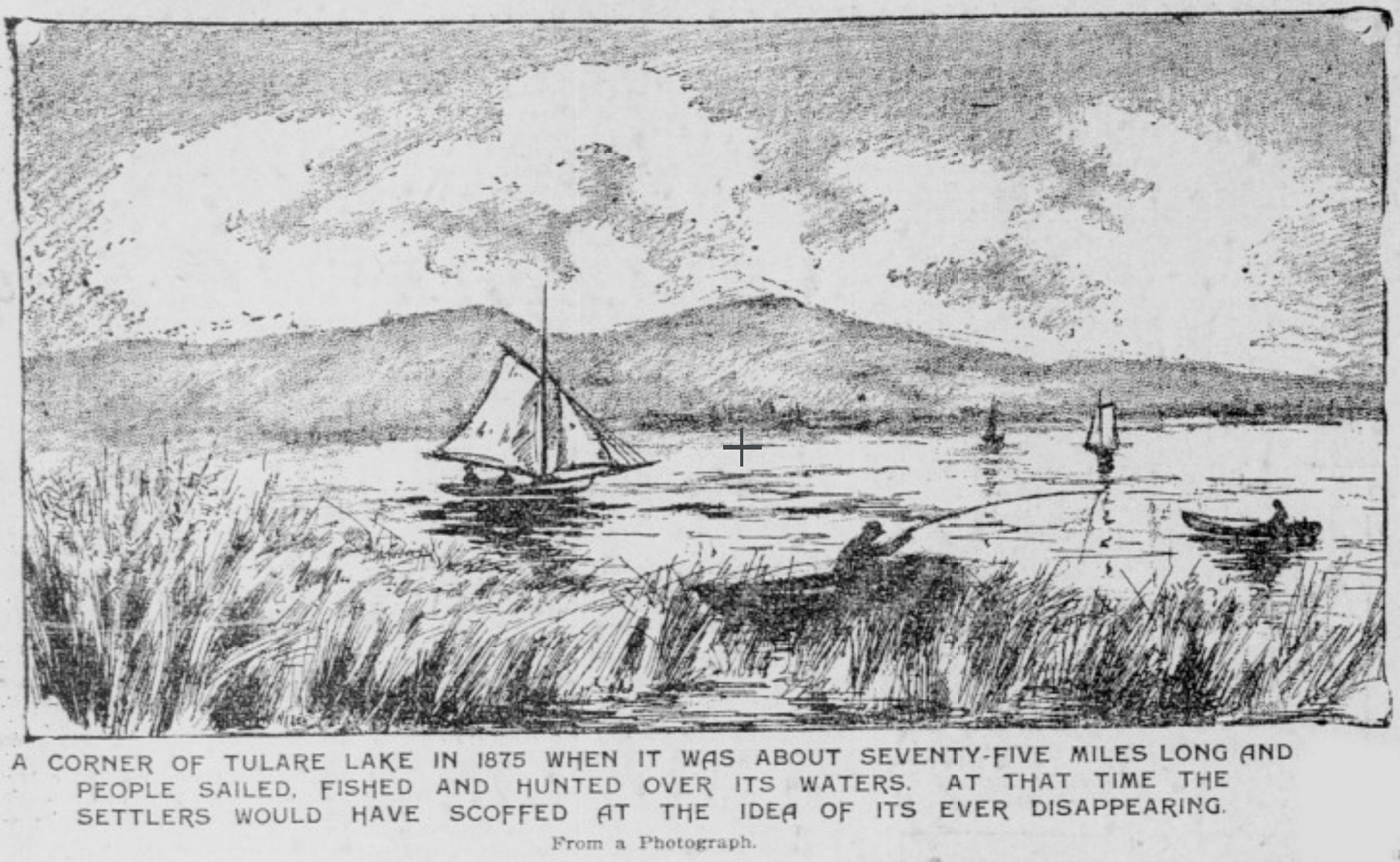
Images: photograph of the Kings River, central to the plot of 1887 The Day They Turned Off the Water, and line drawing of Tulare Lake in 1875 both public domain via Wikimedia Commons; photograph of Topper herding words © A. E. Wasserman; photograph of A. E. Wasserman and Topper the Muse © Pamela Corey, Fur Family Photos, LA.