Pages

Showing posts with label writing. Show all posts

Friday, January 27, 2023

The Pull of the Past

It’s said that there are no new plots for novels, only a recircling and revisiting of a few foundational stories, many of which date from antiquity. Boy Meets Girl, Hero’s Journey, Separation from Parents, Who Killed X and Why?—most fiction, especially genre fiction, can be shoehorned into categories like these. This is not an accident: stories exist to meet the needs and expectations of readers. Each of us is unique, to be sure, but we all go through a similar process of maturation, whatever distinctive forms our own families, cultures, and selves take as we traverse the path.

As a result, the creativity and freshness that a given author applies to the fundamental questions expressed in these plots inherited from antiquity (or the Renaissance) are what sets a particular novel above the rest. As Susan Stokes-Chapman discusses in her recent New Books Network interview, she began with a historical event but ended up transposing the ancient Greek myth of Pandora’s Box to eighteenth-century London. There the fight for possession of a massive urn recovered from a Mediterranean shipwreck releases into the world the many ills that beset humanity: greed, envy, anger, dishonesty, and more—leaving its shattered survivors with only hope, as in the original myth.

Bits and pieces of the genre plots I list above also appear, but the whole is so deftly handled that we barely notice them because of the originality of the approach. So give the interview a listen, then read the book. It’s not an accident that the New York Times Book Review picked Pandora for its short list on historical fiction the very week of its release in the US.


As usual, the rest of this post comes from New Books in Historical Fiction.


It is the very end of the eighteenth century, and Pandora Blake—known as Dora—lives at the edge of London society. Despite the opposition of her obnoxious uncle Hezekiah and his live-in housekeeper/mistress Lottie, neither of whom has much interest in their orphaned charge, Dora has a dream. She wants to sketch jewelry designs that will appeal to the beauties of the haut ton, in the process earning Dora a livelihood sufficient to free her from her family’s antique shop, now in decline due to Hezekiah’s mismanagement. To that end, Dora spends hours in her attic bedchamber drawing with only her beloved magpie, Hermes, for company.

Even before we meet Dora in this enchanting yet troubling tale, we have encountered an unnamed diver bent on retrieving the cargo from a scuttered ship somewhere in the Mediterranean. It soon becomes clear that the mysterious cargo includes a massive Greek vase (more properly, a pithos, used for storing wine or grain), which Hezekiah acquires, together with a shipment of Greek pottery. Dora at first believes this is an attempt to save the store, but her uncle’s behavior raises questions—not least whether he obtained the pithos legally. To find out what Hezekiah has in mind, Dora enlists the help of a bookbinder, Edward Lawrence, setting them off on a journey that will lead deep into Dora’s past.

This is a novel of many layers, as intricately plotted as Dora’s jewelry designs, which seem to have inspired the book’s gorgeous cover. The characters and setting are Dickensian, yet the themes are modern and the reconsideration of the mythical story of Pandora’s Box rings true. Definitely a book worth reading.

Image: Pithos from Crete, ca. 675 BCE, public domain via Wikimedia Commons.

Friday, January 20, 2023

The Bachelor, Medieval Russian Style

As promised, this past Tuesday Five Directions Press formally announced the release of my latest Songs of Steppe & Forest novel, Song of the Storyteller. As you might guess from the title of this post, I had a lot of fun writing this particular novel—and for several reasons.

First, Lyuba is the kind of heroine I find easy to connect to: strong-minded yet thoughtful, self-aware, and in love with words. Although I accept that every character, even the villains, represents one or more elements of myself, Lyuba—like her predecessor Nasan—is not so much me as the person I wish I could have been at sixteen. She has a poise I lacked (I was neurotically silent and shy), yet she loves stories, just as I have since before I even learned how to read. And although she’s beautiful—another trait I wouldn’t lay claim to—she has little awareness of and no interest in that fact; she cares far more about people’s minds and hearts than their looks—even her love interest Timur’s, although she’s certainly not immune to his charms.

Best of all, from the perspective of storytelling, Lyuba is a writer, so she naturally thinks in terms of describing the scenes she experiences, the settings in which they take place, and the characters she meets—and she meets some real doozies in the course of this book. She’ll exaggerate for effect and dramatic impact, but she’s also alert to hidden vulnerabilities and subtexts. The more I submerged myself in her world and her way of seeing, the more readily the story flowed. Even her passing remarks—grumbling when people interrupt her while she’s crafting a sentence, for example—fit both who she is and the unique experience of producing fiction.

Other writers will understand what I mean by that. People who, in Lyuba’s words, “don’t live with stories buzzing inside their heads” may find it strange. Aren’t all characters the author’s creation, like paper dolls dressed up and moved around a cardboard stage? Why would one heroine be easier to write than another?

But in fact, novel writing doesn’t work like that at all. Characters emerge from the subconscious, and the writing flows naturally from letting them chart their own course. My only experiences with the dreaded writer’s block have been when I tried to force a character into behavior that met the needs of the plot but not the personality of the character. Like real people, though, not all characters move comfortably in the larger world. The shy and ungainly, the poorly educated, the girls trained to silent submission (so common throughout much of history)—discovering what makes such heroines unique and memorable can take months, if not years. So when I come across a self-aware, active, fiery heroine like Lyuba, with her vast vocabulary and her talent for nailing in a few words what distinguishes each person she encounters, that’s a gift.

The second factor that eased the writing of this novel was the historical backdrop. From the moment I realized that Lyuba would be just a month or two younger than Ivan the Terrible when the tsar reached the age of coronation and marriage, I knew I must find a way to set her story during his first bride show. Long before I figured out how she would navigate this historical incident that to a modern mind almost defies belief, I wanted to examine the bride show from her perspective. 

Indeed, the natural drama in this incident lets the story almost tell itself. In a country where it might take half a year in travel time to obtain a license to buy a horse, a small group of nobles and government officials were allotted less than six weeks to fan out across the provinces, summoning girls from the local towns. The idea was to bring the best (defined as the most beautiful, healthiest, most likely to be fertile, and, of course, virginal) highborn young women to Moscow. There they would be examined by the wives of the Moscow aristocracy, who would then whittle down the selection to a small group considered to be suitable as a potential royal bride. In addition to the qualities of the candidates themselves, the political loyalty of their male relatives and, in particular, the ease with which the new family could be incorporated into the existing pecking order among the elite were prime factors. The tsar got to pick the wife he wanted from that select group, but he probably had no more than fifteen minutes with each of them before deciding. The real work was done before the royal presentations began.

How well that worked in practice is hard to determine. The call for potential brides went out on December 12, 1546, and by February 3, 1547, the tsar had made his choice and held the wedding. What happened between those two dates is pretty much anyone’s guess, although we do have documents detailing the histories of some potential brides and the assignments of roles during the ceremony itself. And, of course, we know who won. It is probably not a coincidence that the girl who made the cut came from the Moscow aristocracy, although at least a few maidens from other towns did undergo the equivalent of background checks.

But from the perspective of fiction, that is not the important element. For reasons I’ve explained in a previous post, bride shows were held before every ruler’s wedding and even for some of the collateral heirs (the “spares,” in modern lingo) between 1505 and 1689. The stakes were high, and as a result, bride shows were rife with behind-the-scenes negotiations and outright skullduggery. Successful candidates died before, or right after, their weddings. Prospective brides developed bizarre illnesses that vanished as quickly as they had arisen after the girls returned home. Nasty rumors of inappropriate behavior ruined reputations—one reason provincial fathers hid their daughters from view rather than let them be selected for the journey to Moscow. The whole thing was a dramatist’s dream, and I had a great time deciding which of the many boulders would obstruct Lyuba’s path to success as she defined it and which would eventually let her reach her chosen goal.

The book description is below, and I hope you enjoy the novel as much as Andrea Penrose (whose Wrexford & Sloane Regency mysteries you should absolutely read if you have not already), who wrote, “C. P. Lesley brings an exotic setting to life with richly textured historical details and a wonderful cast of fascinating characters—it’s an enchanting tale worthy of her clever storyteller heroine!” 

If you do, please consider leaving a review on Amazon or GoodReads. I know time is scarce and the demands on it many, but reviews help other readers find my books by increasing their visibility, and they tell those who do discover the novels whether this is something they might like.


Lyuba Koshkina has long known that her father, an ambitious and unscrupulous nobleman, will stop at nothing to see her wed the grand prince—soon to be crowned as Russia’s first tsar, Ivan the Terrible. A few months after her sixteenth birthday, the call for the tsar’s bride show goes out. But Lyuba has goals of her own, and they do not include a royal marriage. She wants to record the tales that fill her head from morning to night, including the adventures of her own family. One day, she catches a handsome stranger reading her work and realizes that here stands the man she has loved since childhood—and that neither her father nor the Church will permit them to wed.

Timur Alexeevich has spent years away from home, learning from his uncles how to rule a Tatar horde. An unexpected summons brings him back to Moscow and the girl he once thought of as a little sister, now a scintillating, learned, and self-assured beauty destined—at least according to her father—to become Russia’s first tsaritsa. Even the grandson of a khan cannot compete with so exalted a future. All seems lost, until Lyuba discovers that a storyteller has the power to weave her own future from the twists of fate.


Image: Grigory Sedov, The Choice of a Bride (1882), public domain via Wikimedia Commons.

Friday, December 30, 2022

And What a Year It's Been

I’m not sure I’ve ever been so glad to see a year approach its ending as I am to say goodbye to 2022. The year began with a beloved elderly family member going missing (fortunately, he was found before anything bad happened to him) and slogged along from there. A massive project that clogged my work schedule and delayed everything that followed until the beginning of this month, a second crisis (which also ended better than it might have), and an apparently endless series of tasks associated with moving that elderly family member into assisted living left me so tense that three days after my annual Christmas break began, I was just starting to realize that I am on vacation and can get up late or do nothing if I like.

Of course, even this year was not all disruption and chaos. I made the acquaintance of numerous lovely authors through written and podcast conversations; I received an unexpected payment from the New Books Network for ten years of interviews; I had some fascinating outside editing jobs; I acquired several new colleagues whom I enjoy working with; I got a clean bill of health on various issues that had cropped up since the pandemic began; I avoided getting Covid; and my husband and I adopted two gorgeous kittens who are a perfect joy—our older cat doesn’t agree, but that’s a subject for another post.


And last but not least, I finished another novel, the fifth in my Songs of Steppe & Forest series. Song of the Storyteller will be available in early January, as previously announced, and it was a huge amount of fun to write. I also made headway on the next book, and hope to get farther during this break. There are a couple of looming plot holes to fill and two sets of comments from my invaluable writers’ group to address (character inconsistencies, mostly). At the moment, both the story and its main protagonists feel very distant, but regular writing will fix that, and nothing else now stands in the way.

So that’s my year, in a nutshell. Let’s ring out the old, ring in the new, raise a glass of something bubbly, and hope for a less stressful 2023!


Images: Stressed face, Happy New Year, purchased via subscription from clipart.com; kittens © 2022 C. P. Lesley
 

Friday, December 16, 2022

Moving Forward

Just about two weeks from now, I will press the button that officially releases my latest Russian novel, Song of the Storyteller, into the world. The book has been ready for a month, but I learned the hard way that late November/early December is not a good time to publish something new. The demands of Christmas shopping slow everything to a crawl, and even purchasing author copies can take five times as long as normal. Not to mention that the general flood of new releases tends to overwhelm those of us who don’t have the luxury of a big publisher with a fully staffed publicity department at our backs.

No, January—when people have recovered from the holiday madness, perhaps received e-devices of some kind as presents, and (at least in my part of the world) are looking at months of chilly days and long, dark evenings—is a much better time to launch a new book. So this post is a prequel of things to come, not an actual announcement.

Some books are fun to write: they flow like mountain water from the fingers onto the screen; their characters cooperate with interesting takes on things and problems that anyone can relate to, naturally sharing their views with the author because that’s who they are. Other novels have to be hauled, howling and protesting (or, more often, squirreling their secrets away like so many October hazelnuts), into the light.

I’ve had a couple of the latter in this series, as well as some of the former. Juliana (Song of the Siren) was desperate to tell her story; I could barely keep up with the flood of information she poured into my head from morning to night. Grusha (Song of the Shaman) and Darya (Song of the Sisters) were the shy sort; for different reasons, it took me a long time to find the strength at the center of each of them and coax it out to a place where I could see it. Solomonida (Song of the Sinner) had a strong character from the beginning, as well as an interesting problem, but complicating her situation enough to create a compelling story took a lot of work.
 

Then came Lyuba: Lyuba the storyteller, the natural, the heroine I’ve always dreamed of writing. Self-aware even at sixteen, with a fiery temperament offset by her sharp observation of others and of social convention, Lyuba is determined to wrest what she wants from life in the same way as she plots her fairy tales and takes mental notes for the family saga that we know from The Shattered Drum she will one day write. And the situation she faces is both historically real (except for her part in it, of course) and tailor-made for fiction.


In December 1546, Grand Prince Ivan of Russia (soon to be known as Tsar Ivan the Terrible) decided to marry. He too was sixteen, and for various reasons it was decided that he would select a bride from among his own aristocracy rather than make a diplomatic marriage with a foreign princess. A call went out to all the principalities under Moscow’s control, demanding the nobles present their daughters to the government servitors sent to the provincial towns to make the initial selection. Those girls (we don’t know how many), as well as others representing the great Moscow families, were investigated and gradually winnowed to a small group, from whom Ivan selected a bride. Anyone who has read any of my previous Russian novels can guess that Lyuba’s father would leap at this opportunity like a man-sized salmon.

The summoning of potential brides in itself was not uncommon. Ivan’s father had held such a bride show twice, and later tsars continued the practice until Peter the Great abolished it in the eighteenth century as too medieval and Russian. But what makes it perfect for fiction is that the families who got their girls into the contest took it with deadly seriousness—and I do mean deadly. Candidates were poisoned, girls suddenly developed mysterious ailments that lasted just long enough for them to be given the boot, skeletons were dragged out of closets and shoved back into them. Lyuba and her best friend, Anna, are right to wonder if they will make it out of the Kremlin alive.

And they don’t want any part of the contest. Each of them is in love with a young man she cannot have, and neither has any interest in becoming Russia’s first tsaritsa. And if that seems strange, in a world where so many young girls dream of becoming princesses, well, really, would you want to be the wife of Ivan the Terrible?

I should note that while I was working on the final revisions for this novel, Russia launched its unprovoked invasion of Ukraine. As I write this post, that war continues, and for those of us who have spent our adult lives studying the long and complex history of that region, it feels as if the world has shifted on its axis. Given Russia’s current status as an international pariah, even to write sympathetically about the country’s past in a novel is a source of confusion and doubt. The tragedy of lives lost, infrastructure destroyed, childhoods fractured, injuries inflicted, cold and hunger endured makes Lyuba’s struggles trivial.

But I also know that many Russians are equally horrified by the actions of their government—indeed, many Russians have Ukrainian family members. And that is why I nonetheless hope that my fiction can, if nothing else, reveal some of the political assumptions, historical realities, and beliefs about Russia’s place in the world that continue, even five centuries later, to influence its actions.

Among other things, those actions are based on the lie that Ukraine is, and always has been, a part of Russia. The same justification was given for the annexation of Crimea. But my novels take place at a time when neither Crimea nor Ukraine was considered part of Muscovy. Perhaps that is one contribution they can make to the discussion.

You can find out more about Lyuba’s story at https://www.fivedirectionspress.com/song-of-the-storyteller. Meanwhile, I will be returning my fictional focus to Anna, the center of the next novel and, alas, another of those heroines who requires a gentle touch and lots of patience if she’s to find her way into the light.

Image: Grigory Sedov, Tsar Alexei Choosing a Bride (1882), public domain via Wikimedia Commons.

Friday, September 23, 2022

Down the Rabbit Hole

This post ran a few weeks ago on our Five Directions Press blog, but since I haven’t had a writing post in a while, and I was the one who produced it, I decided to repost it here.

Down the Rabbit Hole,
Or, How Not to Get Lost in Your Research
 

As a historical novelist, I do a lot of research. As the host of New Books in Historical Fiction, I interview people who do a lot of research. And since I was a historian before I became a historical novelist, I have to admit that I’m naturally drawn to research. In fact, it’s my favorite part of planning a novel: delving into areas I know nothing about, despite all the years I’ve spent studying early modern Russian history. I have in mind things like Tatar views of religion (The Golden Lynx and The Winged Horse, also Song of the Shaman), banditry in the northern forests (The Swan Princess), the politics of Renaissance Poland (Song of the Siren), sixteenth-century herbal medicine (The Golden Lynx, The Swan Princess, Song of the Steadfast), Ivan the Terrible’s bride shows (Song of the Storyteller), and, of course, the specific political events of any given year, which form the backdrop to all my Russian novels.


The catch is that, just as with characters’ backstories, writers need to know far more about the historical specifics than readers do. It’s a pretty safe bet to say that we’ve all read novels where the author couldn’t resist throwing in every tiny fact or descriptive detail that crossed their path, to the point where our eyes glaze over and we start to wonder whether we really need ten pages on the Battle of Wallingford to understand why the hero admires the heroine.

The problem extends beyond historical fiction, of course. I’ve struggled through contemporary romances where the author lovingly describes every Armani suit and ornamental flourish, fantasy and science fiction novels that spend more time building the world or explaining the technology than presenting characters I care about, and mysteries so focused on the appearance of a body that the personality of the victim fades from view. Without enough detail, a novel can’t come to life and pull the reader in, but too many details smother the story. So where do we draw the line? Or perhaps a better question, for those of us who see research as fun in and of itself, how do we rein ourselves in?


My own approach may not work for every author, but I’ve honed it over the years and pass it along for you to use as seems best to you. In short, I force my research to serve the story rather than exist on its own. Right at the beginning, when I’m thinking about a new book, I start with the characters. Who are the leads? What do they want, at this moment in their lives and long-term? How old are they, and what do they look like? Which social group do they belong to, and how does that affect them? What is their cultural background? Who will stop them from getting what they want?

The answers to most of these questions don’t require research, only imagination—although cultural backgrounds and the lives of people outside the elite can require a bit of digging, especially when the genre is historical. But once I have a sense of whom I’m dealing with and where and when, then I put in as much time as I need to find out, as specifically as possible, what was happening at that moment in history. This can be unexpectedly difficult: most history books don’t operate at the level of individual years, never mind months or days. But I get as close as I can.

What I’m looking for at this early stage is points of tension and conflict, challenges my hero and heroine must overcome, events that would affect them emotionally. I’m also looking for possibilities I might not have considered: arguments about why someone in power made this decision or that, so I can pick the variation that has the greatest dramatic potential. I try not to be flat-out wrong, but where there are multiple explanations, I worry less about which one is “right” than which one will produce the most exciting story and cause the most trouble for my protagonists. I make a list, interspersing those events with the stages of my main characters’ development, turning the general “this happened then” into something my hero and heroine might actually experience and react to in ways that will force them to grow. If an incident—however fascinating—doesn’t contribute to those character arcs, I jettison it. Wistfully, sometimes, and with the hope it will work later on, but ruthlessly.


Once I have a complete list of story events, I set the research aside. From then on, I focus on answering specific questions as they arise. Do I need to know what a sixteenth-century Russian healer would use to treat fever? I search for an answer to that question. Am I wondering what mica windows actually looked like? I go online and try to find pictures. Does my character need a suitable ballgown for Kraków in the 1540s—or the 1560s? I check out paintings from that time and pick elements that fit her style. The Internet is an amazing resource, but if you’re not careful, it can suck you in and churn you into butter before it spits you out.

Of course, I’m no less susceptible than anyone else to the lures of procrastination. Sometimes I too dive into a research rabbit hole and don’t emerge for days. But most of the time, this method works. And when I do forget and throw in more information than any reader really wants to know, I can always rely on my trusty critique partners to point out where I lost them.

That brings me to my last suggestion for avoiding the research trap: beta readers. Whether it comes from fellow writers or avid bookworms, there’s nothing like friendly feedback to keep a writer from supplying not enough information—or, more often, too much. Just remember: in the end, readers don’t care how many hours you spent perusing books and websites. They want a good, fast-paced story—rich in description and complex characters, yes, but not at the expense of the action. Keep that point in mind, and your research will remain in the background, where it belongs.

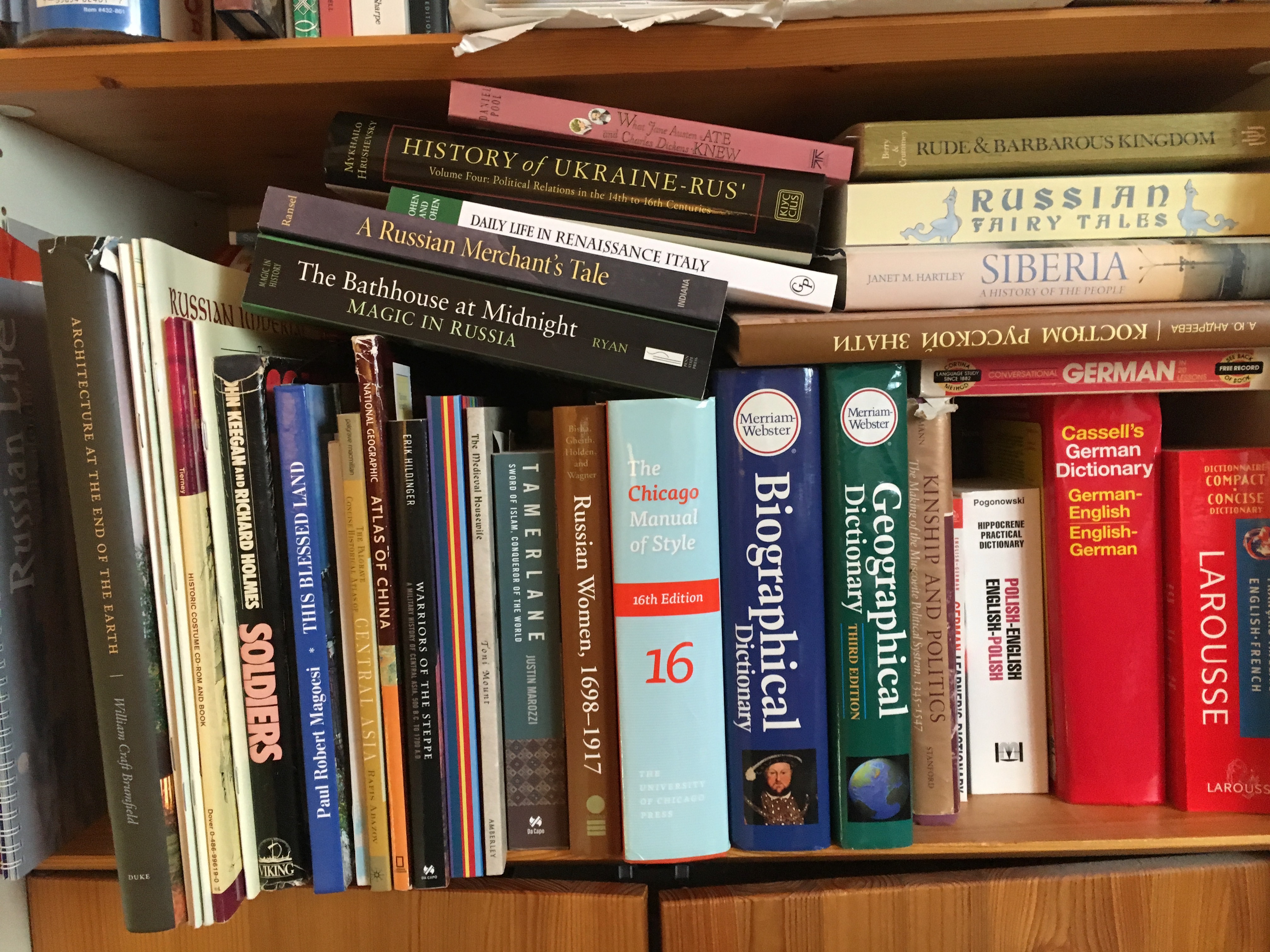
Images: Photograph of my overstuffed bookshelf © 2021 C. P. Lesley; cropped paintings by Konstantin Makovsky, The Tsar Chooses a Bride (1886) and Hans Holbein, The Ambassadors (1533)—my inspiration for the bride show in Song of the Storyteller and Felix in Song of the Siren, respectively—public domain via Wikimedia Commons.

Friday, February 18, 2022

Pushing the Envelope

Yesterday I changed the water bottle in our garage cooler. This was a stretch for me, in part because the bottle is heavy but also because, in a family with two mechanically minded members, I am the outlier. I felt certain that if a way existed to spray water across the floor, the car, and myself, I would find it. But I was the only person around at the time, and it needed to be done, so after a bit of investigation I decided to tackle the problem.


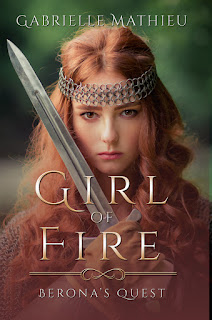
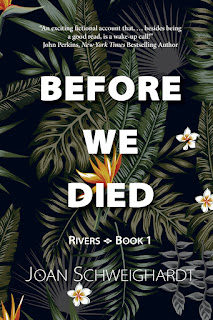
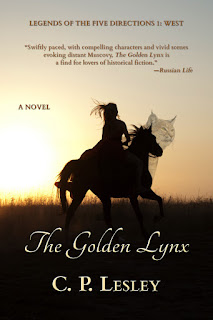
As things turned out, the process was simple enough that even I couldn’t mess it up, but it got me thinking about the demands that we as novelists impose on our characters. Except perhaps in a romantic comedy (where everything would go wrong, bringing hero and heroine together), reading about changing a water bottle, even one containing five gallons or so, would be a complete snore. Protagonists in novels have to surmount the kinds of obstacles that would cause most of us to run screaming for the hills. Just to cite a few examples published by Five Directions Press, plots can include an eighteen-year-old asked to defeat an ancient demon bent on destroying the humanity she once created (Gabrielle Mathieu, Girl of Fire); a sheltered sixteen-year-old girl confronting a known murderer intent on kidnapping two royal princes (my own Golden Lynx); and a pair of young men who embark on a voyage to the Amazon River in search of cash, only to endure a series of disasters that eliminates one member of their group after another (Joan Schweighardt, Before We Died).

So what is it with writers? Are we sadists in nerd clothing? “Psychologically distoybed,” in the words of West Side Story? Desperate for adventure but too wedded to our computers (and too isolated by nature) to seek it for ourselves?


Well, maybe some of the last. It is a great deal of fun to invent these extreme circumstances and throw oneself into imagining how a given character might cope with them. Channeling bad guys (and gals) is deliciously freeing too, so long as one can stash them away in their cages at the end of the day. And of course, one can never rule out hidden sadism or other forms of psychological disturbance. The general public probably already has its suspicions of people who claim to hear fictional beings chattering in their heads, even if those writers don’t themselves believe that the beings exist in any meaningful way.

But the real reason we torture our characters is simple: it makes for a good story. As readers, we get to sit back and watch, turn over potential responses in our minds, guess what the characters may do. We can live life in the fast lane without leaving our seats, and in doing so, we can explore emotions we hope never to experience: the yearning for revenge; the terror of facing a superior opponent; the moral quandary of balancing safety or reward against awareness of others’ needs or adherence to the social rules we were raised to respect. We can watch others make appallingly bad choices or rise to heroic heights we can only dream of reaching. In doing so, we prepare ourselves to face future crises. And no one is hurt in the process.


Or, to riff on Nancy Kress’s marvelous summary in her writing manual Dynamic Characters (“In life we want tranquillity; in our fiction we want an unholy mess, preferably getting unholier page by page” [159]), in life we want to worry about nothing worse than spilling water on the garage floor. In a novel, we want, if not murder and mayhem, at least an angry demon, a ruthless politician, or an environment filled with tarantulas, piranhas, and a jaguar or two. Much better to face such threats on the page than in real life!


Friday, February 4, 2022

Dressing the Part

This post went up on the Five Directions Press newsletter page last week. You can find more of our writing posts—as well as monthly lists of Books We Loved and other news for writers and readers—by clicking the above link. But this one goes well with my own recent release, Song of the Sinner (Songs of Steppe and Forest 4), so I thought it would be fun to share it here as well.

Imagine that it’s pre-COVID days and you walk into a party. Across the room, you see someone you know but haven’t encountered for a while. What’s the first thing you notice? In my latest novel—Song of the Sinner, released just a few days ago—the heroine, Solomonida, describes her impressions of Anfim, the novel’s hero, this way:

His light brown hair gleamed in the light cast by the torches placed at intervals along walls painted in patterns of scarlet and sky-blue; and he was, as always, discreetly but luxuriously dressed—tonight in rich brown velvet with clasps formed from gold braid. Next to the brilliantly clad noblemen and noblewomen he looked like a wren amid a flock of peafowl, but at the sight of him my heart gave a skip.

Superficial, you say? Well, of course. Yet don’t we all instinctively judge not just character but social position and even mood from a person’s clothes, haircut, makeup or lack thereof, and other external traits?

In fact, Anfim’s clothing choices convey quite a bit about him. He has money—enough to afford velvet and gold braid. Even so, he seeks to avoid standing out in a crowd, because he is not one of the “brilliantly clad noblemen”—which tells us that he is not at the highest level of his society but knows his place in the world and accepts the limitations it imposes on him. He plays by the rules, not reaching for more than he can attain by his own merits . More deeply, as becomes obvious the more we learn about him, he is comfortable in his own skin, willing to appear “like a wren amid a flock of peafowl.”

Let’s contrast him with the novel’s main antagonist, Solomonida’s cousin Igor.

As usual, our cousin had dressed in a style designed to cast every other guest into the shade. Today he’d outdone himself in a cloth-of-gold robe tied with an embroidered cobalt sash, its hue repeated in his leather boots and silken cap trimmed with white fox fur. A gem-studded collar that would not have looked amiss on the grand prince himself adorned Igor’s thick neck.

If Anfim downplays his considerable gifts by dressing modestly, Igor takes the exact opposite approach. He wants to make a big splash, hovering on the edge of inappropriate. In a society where conspicuous consumption acts as a marker of who outranks whom, does the grand prince want his lesser nobles rivaling him in their jewelry or drawing attention to themselves in cloth-of-gold and the rare fur of white foxes? Probably not, but Igor doesn’t care. He may not have achieved the place in life that he believes he’s entitled to, but he’s prepared to do whatever it takes to convince people that he’s better than he is. Fake it till you make it is his motto.

But not always. A man as clothing-obsessed as Igor knows when to use his choice of dress to convey disdain as well as to pump up people’s impression of his rank. During a family meeting intended as a last-ditch attempt to force him to confess the full extent of his schemes and deter him from doing future damage, Solomonida notes her cousin’s uncharacteristic slovenliness. She also contrasts Igor’s appearance with Anfim’s to show their opposing attitudes toward the meeting.

I noticed as soon as I entered the main sitting room that our cousin had not dressed up for the occasion. Even Anfim, resplendent in the russet robe he’d worn for our wedding, outshone Igor. I read our cousin’s plain clothes as evidence of disinterest or disrespect. Not, perhaps, a promising beginning.
 

At other times, though, Solomonida is the one manipulating the social meaning of clothing, as in this scene when she sneaks out of the house with her lover, dressed in a servant’s cloak and a robe usually donned for housework.

When Anfim left that evening, I went with him, dressed in Masha’s cloak—its hood concealing my face. I wore my simplest robe, left my headdress behind, and for the first time since my betrothal seventeen years before redid my hair in the single braid typical of never-married girls.

This is clothing as disguise—a trope of historical and fantasy fiction, in particular, where a heroine often dons servants’ or boys’ clothes to evade restrictions placed on women. As such, it gets to the heart of this post: that something that appears to have implications only on the surface can open a window onto a character’s motives and desires.

All these examples come from a novel set in the past, at a time when laws existed throughout much of Europe specifying who could wear what when, giving the details of fashion a punch that they can’t quite sustain in today’s more liberal climate. But in modern life, too, we define the people we meet by the shoes they don, their preference for denim versus corduroy or cashmere, the colors and styles they wear, their devotion to brand names or thrift stores, and the level of interest they show in the details of personal appearance. And we ourselves manipulate those details to convey a particular impression to a given audience, in ways that may or may not correspond to the person we are inside.

So if you are writing a novel in any time or place, think not only about what a character wants and needs but the image that person seeks to present to the world in this set of circumstances or that. And mix it up a bit, because just as wearing a collar worthy of the grand prince doesn’t make Igor equal to his ruler, a character who dons a tweed jacket with leather elbow covers may not really be a professor. Write yourself a wolf in sheep’s clothing, and if the other characters accept the image as reality, you might just have the hints of a plot.

All images public domain via Wikimedia Commons. Find out more about Song of the Sinner at https://www.fivedirectionspress.com/song-of-the-sinner.

Friday, September 3, 2021

The Mechanical Jeeves

About a month ago, one of my fellow Five Directions Press writers shared on our group’s Facebook page a link to a post by the BBC that asked the provocative question, “Can Technology Help Authors Write a Book?”

Being something of a geek when it comes to writing software, I read the BBC post with interest. It features a program called Lynit, now in beta testing, that supposedly allows authors to track characters, plot arcs, and more.

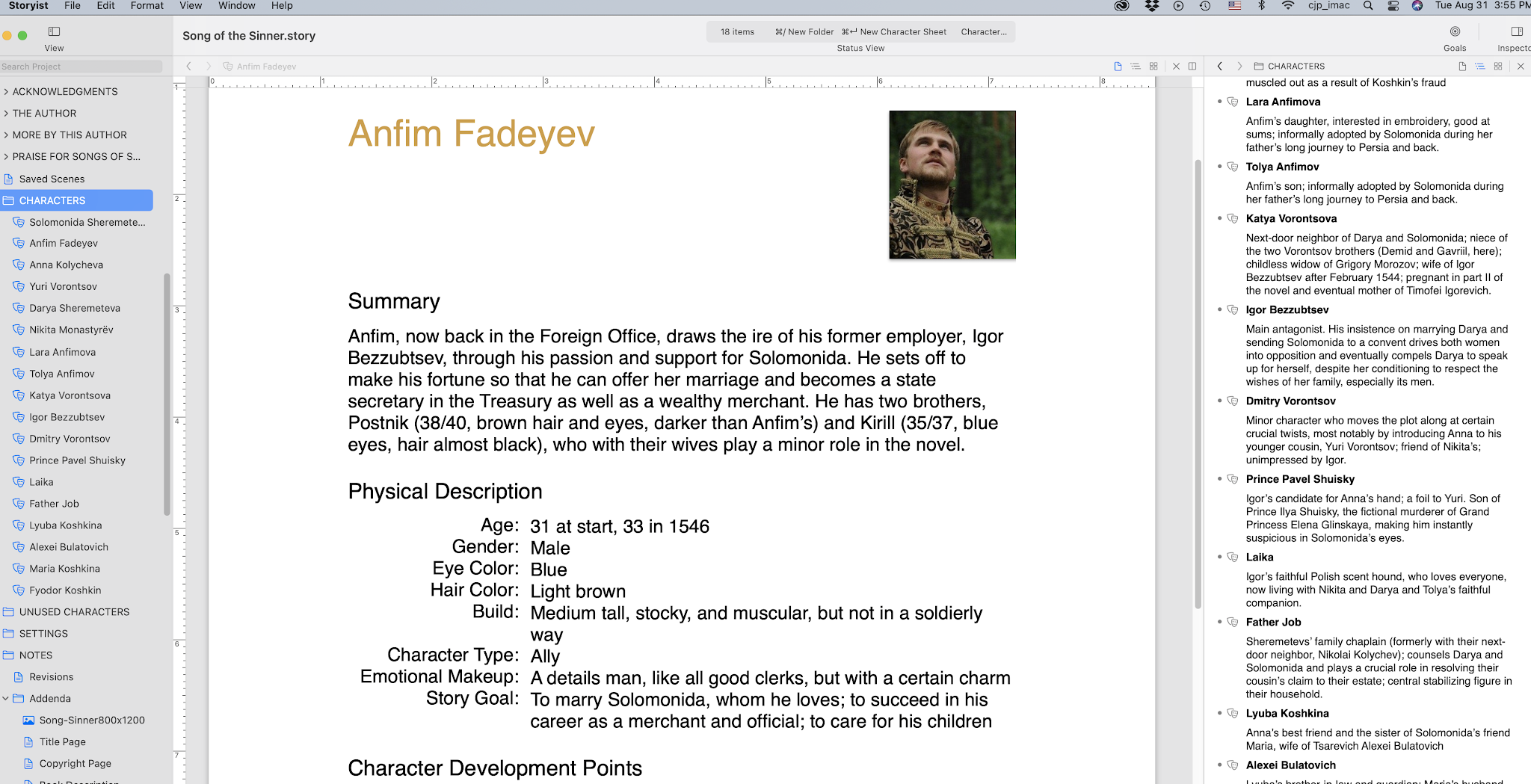
Now, I have nothing against Lynit, which I haven’t tried. But I was surprised to see this approach presented as something new. Not long after I began this blog in 2012, I wrote a post on my own favorite writing program, Storyist. It’s Mac-only on a desktop but has well-regarded iPad and iPhone versions, and it not only stores information about characters, plot, settings, research, and pretty much anything else I might need as reference—including pictures of my characters on a virtual corkboard—but supplies useful prompts about sources of conflict (in plot sheets), sensory information (settings sheets), and character development (character sheets). All these can be linked and displayed as index cards or outlines—leaving numerous different ways to approach a story to suit the needs of different writers.


In Storyist, the novel itself lives in a single manuscript composed of chapters and scenes that can be dragged into new positions or exported to styled RTF for Word import or to Kindle/ePub formats for reading. I use it every day I write; indeed, I keep my blog posts in it too, because it doesn’t throw in all the junk that Word does, which can complicate copying the text to Blogger, and it lets me stash a year’s posts in one place. Eventually, when I have a final draft, I import that RTF into InDesign or Affinity Publisher for typesetting.


But I don’t produce final e-books in Storyist, which has sufficient formatting controls for basic reading but not for publishing, in my view. For that I use Scrivener, which has a Windows version as well as Mac and tablet apps; many authors love it as much as I love Storyist. Its exact mix of features is, as one would expect, somewhat different, but it too stores research files and a separate manuscript with chapters and scenes. It supplies sheets for storing information on plot, characters, and setting, although they are more rudimentary than Storyist’s. It also stores each clipping of the manuscript as a separate file that must be compiled before use, which gives a writer a great deal of flexibility on export but can be annoying when you suddenly realize that what looks on screen like a single document is actually 150 disconnected pieces. Both Storyist and Scrivener can support more than one manuscript in a given file.


One plus of Scrivener is that it can link to the third program I use—much more intermittently than either of the two previous ones, but that says more about the way I write than the value of the program—Aeon Timeline. Of the three, this is the setup closest to Lynit. As the name suggests, Aeon Timeline allows you to visually display story events and character development over periods ranging from hours to centuries. I used it especially for my novels The Swan Princess (three point-of-view characters operating more or less independently, making it important to know where each one was relative to the others at a given point in the story) and Song of the Sinner (spans 1543–46, with a gap in the middle, during which the hero and heroine are out of contact with each other). I also use it when I’m plotting a story against a detailed historical background, so that I can chart where my invented lives intersect with reality, as in The Vermilion Bird. I haven’t used Aeon Timeline enough to test its limits, but it does allow writers to define their own calendars, so it should be possible to adapt it for all kinds of fiction.


Because, as I said above, I’m rather a geek about writing and publishing software, I have also in the past dipped a toe into Dramatica and Story Weaver, as well as other writing programs too numerous to mention. But do any of them really “help authors write a book”?

Well, yes, if what you mean by “help” is keeping track of information that can be easily lost—that passing mention to a character’s physical characteristics or age, the neat site you found online that explained Tatar wedding customs or calculated the date of Easter according to the Julian character in 1552, the great “what if?” option that came to you the night before which you don’t want to forget, even ideas for other novels that can be stowed in a note to keep you from haring off after them instead of focusing on the book underway. Both Storyist and Scrivener are great for those kinds of tasks, and having the information in the same program as your manuscript so you can click over to the note to check and back again to your writing can prove very handy. Similarly, on those occasions when you need to plot out a character arc or overlapping plot lines, Aeon Timeline or (probably) Lynit would simplify that work. 

But alas, whatever their strengths, I don’t think any of these programs can really help you turn a story into a novel. To make that happen, you need to sit down, start typing, let the ideas flow, share the results with respected fellow writers, establish a small library of great books on the craft of writing to which you return over and over, and—last but far from least—revise, revise, revise. And the time put into learning a slew of programs might better be spent typing rough drafts. It’s too easy to get lost in the weeds of technology and forget that its fundamental purpose is to facilitate the act of writing, not to influence its content.

Writing a novel, whether it’s 50,000 words or 100,000, is a marathon, not a sprint, as they say. No piece of software can change that reality. What they can do is provide a good valet or butler, always at hand with a tray or a freshly pressed coat. Think P.G. Wodehouse’s Jeeves with a dash of Star Trek’s Commander Data, and you’ll just about know what to expect.


Images are screenshots of my own copyrighted work, except for the last, purchased via subscription from Clipart.com.

Friday, August 27, 2021

Getting the Word Out

Long-time readers may have noticed that I don’t write too many social media or marketing posts. That’s because I’m actually terrible at marketing. Between work and my novels and the blog and my podcast, I don’t have a lot of free time. But if I’m to be completely honest, I also don’t choose to spend much of the little free time I do have on marketing, even though I know from other people’s experience that it would help me sell books. As a result, I don’t have a lot of surefire tips to share with other aspiring writers.

Another discouraging reality is the speed at which the Internet Age changes: Facebook is hot, then it’s everywhere, then it’s passé and replaced by TikTok, which next year will no doubt give way to something else. It’s a full-time job just keeping up, never mind leaping ahead of the curve. And the more entrenched a writer becomes in one community, the harder it is to pick up and move to another, where the old relationships must be rebuilt.

That said, after nine years of publishing fiction, I have learned a few things about what works and what doesn’t. Since this blog goes beyond interviews with other authors (enjoyable as those are), news about my ongoing projects, and historical tidbits to include publishing, media, and marketing, I thought I would take today to mention some of the insights I’ve acquired.

1. Produce a good book.

Without this step, you have nothing to sell, yet it’s the one budding writers pay the least attention to. The joy of finishing is extreme, and I revel in it as much as the next person, but it’s a rare book that succeeds without extensive critiquing and rewriting. This is as true of novels being sent to a literary agent for representation as for those destined for self-publication in any form. Be prepared to write draft after draft before a first novel is done. After that, the process gets easier, but multiple revisions are still required to make a book sing.

Once you finish the writing, your project will need competent copy editing (and yes, most of the time, you get what you pay for), production, cover design, and e-book formatting. Only then should the question of marketing even arise.

2. Make use of existing contacts.

Sad but true: nothing beats a built-in audience. The journal I edit has acquired 2,500+ followers on Facebook and Twitter with posts that rarely exceed one per month. Why? Because people already knew about it. It took a decade to build that audience outside of social media, but once built, it transferred without so much as a hiccup.

For writers starting out, that means emphasizing local events, like-minded friends, neighbors, and relatives. I know authors who have sold books through their hairdressers, and more power to them. I had some luck with my local libraries and the Rotary Club, although my best audience is other scholars in my field (the ones who rightly assume I don’t distort history in the service of fiction, although I have encountered a few skeptics). The advantage of the Internet Age is that everything is international, but that means billions of people trying to connect at the same time. The noise level alone tends to drown those starting out, although worldwide availability pays off in the end.

3. Focus your efforts.

This extends from the point raised above: that social media change faster than haute couture fashion. There’s no hope of remaining on top of everything, but if you avoid social media altogether, you’re unlikely to get out of your own local box.

The solution is to pick one or two things you can commit to on a regular basis. For me, it’s my blog (steady, every week), Facebook (3–5 times a week with selected groups), and Twitter (same as Facebook with the addition of #1linewed—a group effort that invites writers to share one line of a work-in-progress that includes a word set by the coordinator each week; search for the hashtag to see it in operation). And, of course, my podcast interviews, which post 1–2 times a month and which I lucked into back in 2012, when podcasting was up-and-coming. Alas for others, podcasting is everywhere now, so if you pursue it, go with an established group like the New Books Network rather than starting out on your own.

For you, it may be TikTok videos or Instagram or something entirely new. The point is to try out various options until you find a half-dozen or so you like enough to keep up with them, then go for it.

4. Forget about e-mail lists.

I don’t mean this literally. If you have a group of trusted friends or avid readers who want to find out when each of your books sees the light of day, by all means let them know! That’s part of point 2, using the connections you have. My publisher sends press releases to people who sign up for them, and I forward those to friends and neighbors who have said they want to stay informed.


But I no longer bother with newsletters myself. Instead, I contribute to the group posts my writers’ coop produces. I can’t tell you how many times a week I’m inundated with unwanted “news” because someone got hold of my e-mail address and signed me up without my permission (which is illegal, by the way). I usually don’t bother to unsubscribe, because I prefer not to upset authors I may want to interview one day. I don’t read the newsletters, though, and seeing them irritates me. You’ll still see advice to keep lists of e-mail addresses in various author marketing venues, but think about it: who under 50 even checks their e-mail regularly these days?


5. Try book teasers instead.

This advice assumes you have an artistic sense, an understanding of fonts and copyrighted images, experience with publishing software, and an ability to write dramatic lines. If you don’t, find someone who does. But if you do, these are a lot of fun to create and give readers a sense of your book. They pull people in without being a hard sell, which is the secret to marketing in general. And you can rerun them on social media in sequences, providing useful memory joggers for those who may be interested but distracted by the many other calls for their attention.


A similar approach—although I’ve never tried them—involves video trailers. My sense is that these work best if you already have an online presence and want to expand it. The technical demands are higher than those of book teasers, and there is more competition for eyes on a site like YouTube, whereas on Twitter and Facebook things flash past too quickly for anything with motion in it. YouTube also switches from one video to another in ways that make it hard to stay in touch with a single author even if you know who to look for. But other sites may be easier. If your mind naturally turns toward short videos, it would be worth experimenting to see what works for you.

6. Help other writers.

There is, of course, a danger in being caught up in social contexts made up solely of authors shouting their wares to other authors. But authors are also readers, and they have high standards for what they embrace. They can leave wonderful reviews, tout you on their sites, interview you, endorse your books—in return for sharing the publicity, which helps them too. And in my experience, most authors are wonderful people. Sure, some refuse to help, but many love to assist those starting out. If nothing else, it’s good karma, and we can all use a bit of that.

7. Keep writing.
 

It takes time to establish a reputation for producing good work, as noted above, as well as time to master the craft of writing. Once you do find readers, they will hope for more than one book. And with so many other prospects out there, you want to hook their attention while you can, so they will come back again and again. The only way to ensure that is to keep producing great books for them to read. Or, to paraphrase a well-known saying, “a writer’s greatest asset is her backlist.” So whatever happens, don’t give up. 


In the last nine years, I have published eleven well-regarded novels, produced well over 100 podcast interviews, written 400+ blog posts, and seen my blog readership go from 100 to 11,000 a month. Even so, I’m still waiting for my annual book sales to get out of the triple digits.

Some people would probably advise me to quit, but why would I? I don’t write to sell books; I write because I love watching and recording the developments in my fictional world. Sharing the results with others is just the icing on the cake. And if anything I’ve written here helps you, so much the better. 

There are other avenues to get the word out that I haven’t mentioned, of course. Feel free to share your tips and suggestions in the comments below.

Images from various sources, many previously published on this blog (and attributed in the original posts) and all either purchased via subscription, copyrighted by myself, or sent to me for distribution (the blog award).

Friday, April 30, 2021

Someone Else's Universe

Fan fiction has something of a bad rep in the writing and reviewing community. People wonder: Could you not come up with your own ideas? Why borrow someone else’s creative universe?

At the same time, the publishing industry loves a certain kind of fan fiction. How else can we explain the endless progression of novels featuring the various Jane Austen heroines,
Sherlock Holmes, and fairy tales? The larger the publisher, the more dependent it is on titles that will sell in the millions, not the hundreds, and the more attracted its editors are by the “sure thing.”

But the part that often gets lost is what writing (as distinct from publishing) fan fiction can do for an author just getting started. My first novel—excruciatingly bad as only the first drafts of a first novel can be and never published because of copyright constraints—was based on a Star Trek story I had told to myself for years. Not exactly an original story, because it could be classified as part of a category stuffed to the gills by other aspiring fan fiction writers, but all mine in its particulars.

I learned a lot while laying down that execrable prose, and more as I crafted it into better versions of the same, then rewrote it from scratch (more than once) while transitioning it to a new book set in a world of my own creation. Even then, I let it sit for almost two decades before giving it one more thorough overhaul and allowing Five Directions Press to publish it with every trace of the original, borrowed universe removed.

My second novel, the first to see the light of day, is an even more explicit example of fan fiction, evident in the title: The Not Exactly Scarlet Pimpernel. Again, it originated in a reworking of Baroness Orczy’s classic tale that I amused myself with at odd moments, then wrote down—only to realize that by resolving the original conflict I had run out of story within fifty pages. I learned a lot from that, too, and because The Scarlet Pimpernel was published in 1905 and is thus in the public domain, I was able to bring out my version with explicit acknowledgment of and thanks to Baroness Emmuska Orczy (less than 30 percent of the finished novel draws on her original, blended with a BBC production based on her work).

Even before I finished The Not Exactly Scarlet Pimpernel, I had abandoned fan fiction entirely and moved into my own Russian-inflected historical world, now represented by eight novels in print and two more in the works. But the point is that I would never have written any of them had I not decided on that long-ago summer day to type out one scene from my highly unprofessional Star Trek story to ensure that I didn’t forget exactly how I wanted it to go.

So if you have a great idea for the perfect solution to Marianne Dashwood’s romantic problems, don’t hesitate. Writing is not the same as publishing (although if you can land a publishing contract, more power to you), and in the beginning it’s best not to get caught up in fantasies of publication anyway—first books are seldom good enough right off the bat. But writing fan fiction beats not writing at all. And I can promise you, even by roaming around in someone else’s creative universe, you can learn a lot about what it takes to bring your own to life.

Images: Old man surrounded by imaginary beings purchased on subscription from Clipart, no. 314581; photograph of Baroness Emmuska Orczy (1920), public domain via Wikimedia Commons.

Friday, March 26, 2021

Bringing Characters to Life

One of the most difficult tasks for any novelist, including myself, is to create characters who seem like real people: more noble, often, or more evil than the rest of us—depending on their role in the story—but neither wholly one nor completely the other and, most of all, distinct. Characters like that grow beyond an individual book and achieve a kind of immortality. Long after we have forgotten the plot details of Little Women or Anna Karenina or Vanity Fair, we remember Jo March and her saintly sister Beth, the doomed Anna and her faithless Vronsky, and Becky Sharp.

It’s true that after a while characters acquire a certain kind of life; they say and do things an author doesn’t expect. Such behavior offers insights into their being and makes a writer’s life easier. It’s also true that some characters arrive fully formed, with their own voices and traits, whereas others hide and require extensive coaxing to reveal their hidden selves, their goals.

But it’s equally true that showing those developed characters from the very beginning of a novel is a task for the author, and no rewrite should be the last rewrite until that step has taken place. So how does that happen?

I’ll give you a favorite example of mine, one I go back to when wrestling with my own beginnings. It comes from Rhys Bowen’s Her Royal Spyness, and the person speaking is the heroine, Lady Georgiana Rannoch. Her very name hints at her character: although “Lady” has many shades of meaning in British society, it always refers to a noblewoman, and Rannoch is obviously Scots. The Lady First Name, especially for a woman, means a duke’s or perhaps an earl’s daughter; anyone lower is Lady Husband’s Title or Last Name. But in the first line, we find out what it means specifically to Georgiana, known to friends and family as Georgie.

There are two disadvantages to being a minor royal.

First, one is expected to behave as befits a member of the royal family without being given the means to do so.
[A list of royal tasks follows, one that will be familiar to anyone who has been following the latest flap among the Windsors over the departure of Prince Harry and Princess Meghan, followed by examples of the things royals cannot do, including applying for a job at Harrods, something that Georgie plans to attempt this very day.]

When I venture to point out the unfairness of this, I am reminded of the second item on my list. Apparently the only acceptable destiny for a young female member of the house of Windsor is to marry into another of the houses that still seem to litter Europe.

This opening excerpt reveals a surprising amount about what makes Georgie unique. We learn that she is royal, well educated, and quite proper (her use of “one,” for example) but aware of the contradictions in her world, willing to defy convention, and capable of questioning the strictures imposed on her in childhood. She also has a sharp tongue and a sense of humor, made even clearer on the next page, where she describes her grandmother as “the least attractive of Queen Victoria’s daughters,” an apparent burden that allowed Grandma to escape marriage to “a Romanov or a Kaiser, for which I am truly grateful and I expect she was too.”

We’re not two minutes into the story, but we already have Georgie’s quadruple-barreled name, insights into her heritage and approach to life, and most of all a clear sense of who she is. In a sense, as readers we’re already in love, ready to follow her wherever she wants to take us.

Here’s another example, one I encountered just recently while reading Deanna Raybourn’s A Curious Beginning, the first of a series set in late Victorian England starring Veronica Speedwell, the first-person narrator. Again, the first line is presented as action but actually reveals character: “I stared down at the open grave and wished that I could summon a tear.”

In the next line, we learn that Veronica is attending the funeral of Miss Nell Harbottle, “my guardian for the whole of my life,” yet she cannot cry and by the end of the paragraph is disconcerted by a sense of euphoria. “As if to match my mood, the breeze rose a little, and on it fluttered a pair of pale wings edged and spotted with black. ‘Pieris brassicae,’ I murmured to myself. A Large Garden White butterfly, common as grass, but pretty nonetheless.”

You may think that Veronica is just cold, but that’s not the case. She notices butterflies because she has adopted lepidoptery as a profession—in an age where women did not, as a rule, have professions—and to her they symbolize freedom and beauty. Her failure to weep at her guardian’s grave reflects both the relationship between them, “tepid at best,” and a mystery about Veronica’s past that drives the novel and becomes clear only toward the end. Veronica is certainly unconventional, as her having a profession indicates, but she is also passionate about her convictions, enough to get her into a spat with the vicar’s wife within half an hour of the funeral. By the end of chapter 1, we know she has no interest in marriage, that she has had lovers (extraordinary for a young, single Victorian woman), that she treasures foreign adventure and intends to run her own life, and that she doesn’t give a hoot about either gossip or social censure.

Bowen and Raybourn, of course, are big-time authors with large followings—undoubtedly because of writing like this. But even self-published and small-press writers need to aim for the same standard. It’s not easy, but it can be done. At the risk of giving myself more credit than I deserve, here are two openings from my own novels, The Golden Lynx (2012) and Song of the Sisters (2021). The first is told in alternating third-person and the second from the perspective of a first-person narrator, but each book begins with its heroine.

Here is Nasan, the central character of The Golden Lynx and its entire series: 

The lynx found Nasan just before the ambush. She glimpsed its tufted ears through the tangled branches of the birch tree, then lost sight of it when her brother launched his attack. Alerted by his joyous shriek, she jumped sideways and stuck out a foot, sending him somersaulting over the blizzard-kissed ground. She pelted him with snowballs, taunting him. “You forgot again, silly. How can you take me by surprise if you yell like that?”

And here is Darya, at first observing her older sister:

“Oh, Darya, you have to see this. A strutting peacock just entered our yard!” Solomonida stood on tiptoe, leaning forward until I worried she might tumble right through the open window in her eagerness. The late morning sunlight glinted off her jeweled headdress and found an answering glow in the wisps of blonde braid that had worked their way out from under the rim as she sewed.

“Peacock?” I stared at her and sighed. It wasn’t fair. My older sister was lovely, even at thirty-one. Not just beautiful, either, but vivid and charming—outgoing, outspoken, eager to interact with life beyond our courtyard gates. Next to her I felt like the quiet mouse she teasingly called me. “How would a peacock get into our yard?”

So what can we tell about these two  women interacting with their siblings? Nasan is probably a teenager at most, since she still enjoys a snowball fight with her brother. She is active and competitive, and she takes no prisoners, pummeling her brother even when he’s down (we soon see him doing the same to her). Why the lynx is looking for her, we won’t find out for a while, but she notices it lurking, so she is at home in the forest and alert to its perils. Even so, we discover within a page or so that she is in fact courting danger, that she and her brother have defied their parents’ orders to stay within the fortress because of a threat that will sweep them into the story before they know it. So she is courageous and willing to buck authority—or simply young enough to believe in her own invincibility.

Darya, in contrast, views herself—and is viewed by others, so her perceptions are accurate—as a quiet mouse, inferior to her older sister (less pretty and charming), and shy about life outside her estate. She is perceptive and honest as well as observant, and she is not proud. If anything, she underestimates her own worth and defers too readily to others, including her sister. She has a developed aesthetic/artistic sense, describing Solomonida as a painter might. The jeweled headdress indicates that the family is noble, or at least wealthy—unlike Nasan, who at first glance could be anyone, although it soon becomes obvious that she’s at the very top of the social hierarchy, something that concerns her not at all. And the sisters have been sewing, a traditionally female occupation that brands them as fundamentally conventional even though as time goes by they will push at the boundaries of their world. It won’t surprise you, I’m sure, to learn that Nasan would rather do almost anything than ply a needle. Give her a sword and a horse any day.

See how much you can tell from a few sentences? It’s no accident that I use my characters over and over, once I’ve developed them. Finding them takes so much time, and getting them on the page requires an even greater investment. Keeping up with them as they grow is a challenge, too—maybe we'll talk about that another day—but nothing like as hard as getting to know them in the first place.

Even with all that, not everyone will create another Jo March or Becky Sharp. But it’s certainly worth a try.