Pages

Showing posts with label history. Show all posts

Friday, June 16, 2023

Making Stuff Up

I’ve made no secret of the fact that one reason I chose to set my historical novels during the childhood of Ivan the Terrible—who became the nominal ruler of Russia a few months after his third birthday and held the throne until his death at fifty-four—was because the history of that period is so dramatic that the stories almost tell themselves. When I began, I intended to start not long after Ivan’s accession to the throne and end with the suspiciously convenient death of his mother, Grand Princess Elena Glinskaya, four and a half years later. That is, indeed, the span of my first series, Legends of the Five Directions.

But when I found myself with a group of characters whose stories I’d planned to tell but had no room for—having had entirely unrealistic ideas of just how much I could cover in a single book—I was having too much fun to quit and decided to bring the series forward into the even more troubled and chaotic years that followed Elena’s death. That brought me, in due course, to the bride show held for the by then sixteen-year-old Ivan and, as of the current novel, the Great Moscow Fire that followed it. Or more accurately, as I discovered when I began to research the topic, not one fire but a series of three that wreaked havoc on Moscow from mid-April to late June, killing thousands and destroying the livelihood of many more.


This was sixteenth-century Europe, so governments thought nothing of catering to the wealthy and ignoring the woes of the poor. But in this case, so many people lost family members as well as all their belongings that the survivors lost patience with the callousness of those in charge and rioted in the streets. And because this was a time when people liked to blame their misery on sorcery, rumors circulated accusing the tsar’s grandmother, a Serbian princess (rightly or wrongly, Serbians were considered particularly likely to indulge in witchcraft), of turning herself into a bird and flying over Moscow, dripping liquid derived from a human heart to set the city ablaze.

An incredible story, to be sure, and from a historical standpoint highly questionable, not only because of its content but because of when the story appears in the official annals. If I were writing an academic article, I would exhibit extreme skepticism, mining the tale for evidence of who might have gained from spreading such nonsense decades after the last embers of the Great Fire fizzled into ash.

But I’m writing a novel, and the story is wonderfully indicative of how people dealt with trouble back then (and sometimes even today). The question for me is, as always, how to blend the lives and thoughts of my fictional characters into the broader historical arc created by the royal coronation and wedding, followed so closely by the near-destruction of Moscow.

Like most of us, my characters aren’t anticipating disaster; their problems, however important to them, seem quite small next to the larger drama playing out behind them. Yet they must interact with that bigger world, using outside events to solve their issues and get to where they need to go. How do they cope with tragedy? What strengths and weaknesses do they reveal? Do they resist the pressure of the maddened crowd or give in to the prejudices of their day?

I don’t know yet. But I’m about to find out. No doubt Yuri and Anna, like their predecessors, will surprise me. Just a few days ago, a cat showed up in the story and demanded, as cats will, a place at Anna’s side. I have yet to discover what role Mila the Cat will play, although I’m sure she will tell me when I need to know.

But as I write in almost every historical note, the most outrageous events in my novels are almost always historically attested. The old adage really is true: you can’t make this stuff up, because no one would believe you if you did.

As for the most outrageous coincidence in this particular novel, I think I’ll save that for a future post.

Because of changes to Wix, which hosts my main author website, and my own desire to consolidate my author persona in one secure location, I will be transferring my blog to my main site, https://www.cplesley.com, at the end of June 2023. The older posts—dating from June 2012!—will continue to be archived here for as long as I can make that happen.
 

Image: Apollinary Vasnetsov, Boyar Houses at Night (1918) looking distinctly smoky, public domain via Wikimedia Commons.

Friday, March 3, 2023

Defeating Infantile Paralysis

One of the tragic side-effects of the politicization surrounding COVID-19, its origins, and the remarkably rapid development of vaccines aimed at preventing infection has been the resurgence of polio—another highly transmissible, devastating disease that was once close to eradication. In part, the vaccination campaign for polio was so successful that most people now, although they have heard of the disease, have never encountered anyone stricken by it. They have no idea just how terrible—and terrifying—it was in the days when it appeared to be both incurable and impossible to prevent.

In my latest interview for the New Books Network, Lynn Cullen takes us back to that time in the 1940s when even the world’s most dedicated scientists did not know how polio moved through the body, how it was transmitted from one person to another, and how it wreaked so much havoc on vital organs. In particular, Cullen follows the career of one woman, Dorothy Horstmann, a doctor and medical researcher who devoted her life to finding out how polio worked and where intervention might be successful. She went on to apply the same skills to other illnesses, but only after she devoted more than twenty years to studying the disease known as infantile paralysis, although it did not only affect children. President Franklin Delano Roosevelt was one notable example.

It’s a gripping tale, a fictionalized but mostly true story, and one particularly relevant to our time. So give the interview a listen, and then read the book.

The rest of this post comes from New Books in Historical Fiction.


The essential contribution of this novel can be summarized in one sentence: like most of its future readers (I assume), I had never before heard of Dorothy Horstmann and her fundamental role in the research that led to the near-eradication of polio, despite having benefited hugely from her work. Throughout the 1940s, 1950s, and into the 1960s, she devoted her considerable talents and endless hours to tracking how polio spread throughout the body, but like the other remarkable women portrayed in this novel, she was forced because of her gender to play second fiddle to Doctors Jonas Salk and Albert Sabin, her academic colleagues. Their contributions, of course, were also real and worthy of acclaim, but it was Dr. Horstmann—too often dismissed as “Dottie” or “Dot,” as if she were someone’s secretary—who made the crucial discovery that early in its path from the digestive to the nervous system, the polio virus created antibodies in the blood. That finding made the polio vaccine possible by defining an entry point for medical intervention.

Reading this novel has a particular resonance at this moment, when polio outbreaks are again affecting US cities because of vaccine hesitancy and the final eradication of the disease has been deterred in certain countries by political concerns—not to mention the COVID-19 pandemic, which has changed everyone’s experience of quarantine and disease. But I would like to emphasize that this is, first and foremost, a novel, centered on complex characters, a gripping plot, and the age-old battle between science and nature. I don’t know, for example, whether Dorothy’s love interest is a real person or the author’s way of contrasting the attractions of home with the pull exerted by fulfilling work. In the end, it doesn’t matter, because The Woman with the Cure works as a story, provoking questions about the choices its heroine makes and what we might do in similar circumstances—and that’s what counts.

Friday, February 17, 2023

Interview with Dan Jones

Despite having interviewed Bernard Cornwell three times for the New Books Network, and as a result having enjoyed all of his Saxon Chronicles, I am not a big fan of war books in general. So I agreed to read Dan Jones’s Essex Dogs, which released this past Tuesday, with some trepidation. I was pleasantly surprised.

For those who love gritty descriptions of battles and campaigns, behind-the-scenes peeks at the daily life of soldiers in all its filth and profanity, and the push-and-pull between the medieval equivalent of enlisted men and their noble officers, there is plenty here for them to love. Dan Jones is first and foremost a historian, and his grasp of the details and his easy confidence in describing scenery, events, and the many hardships of a military operation on foreign soil make for a compelling tale. The novel follows the English army during its first major campaign of the Hundred Years War, from its landing on the coast of Normandy to the crucial battle at Crécy in August 1346. Suffice it to say that several historical characters—including King Edward III’s son, the chivalric hero known as the Black Prince—appear in an unfamiliar but amusing light.

The story moves fast, and the main characters—a small group of fighting men who call themselves the Essex Dogs—emerge as distinct individuals, each with his own past, personality, and problems. But it is their leader, variously referred to as FitzTalbot and Loveday, who dominates the story. On the rebound from personal tragedy, in a struggle to stay alive  under difficult circumstances, and intent on fulfilling what he perceives as a sacred trust from the group’s prior leader, known only as the Captain, Loveday is determined to keep his small group together no matter what fate throws at them.

What follows is an interview between Dan Jones and his publicist, Ben Peterson (questions in bold). Although I normally insist on conducting my own interviews, I made an exception in this case because Ben has asked the same questions I would have, so it seemed pointless to require a busy author to spend time repeating himself.

A Conversation with Dan Jones

You’re best known for writing books about British history. What prompted and inspired you to write your first novel, Essex Dogs, and why now? How did you prepare?

For some years I’ve been yearning to try my hand at fiction set in the Middle Ages. And plenty of my readers had been asking me when I was going to get around to doing it. As though it were the obvious natural progression in my career. I suppose it figures. My nonfiction books are built on narrative structures borrowed from screenwriting. They celebrate character and explore history through strong, colourful scenic narrative. They smuggle big ideas in under the guise of in-your-face entertainment. These are traits shared with fiction.

I conceived this novel in several stages. The idea of writing about a rogue band of freebooter-soldiers known as the Essex Dogs came to me while I was dozing on a flight from Prague to London in 2017. I began writing about them, but could not settle on the right adventure for them to have. So I shelved the project, and forgot about it until the winter of 2018/2019, when I rented a house in Normandy, quite near Saint-Lô. During a New Year’s Day walk on Omaha Beach with friends, I began to think that having the Dogs take part in Edward III’s 1346 landing a little further up the coast (near Utah Beach) might be viable and fun. A medieval D-Day, kind of like Saving Private Ryan but in fourteenth-century costume. Medieval American hardboiled. Yeah. That felt cool.

Yet even then I dithered. It was not until that summer, after a wide-ranging conversation over dinner with George RR Martin, a history lover whose works of fiction I admire enormously, that something clicked. I went home and started work. George had nothing to do with the writing of this story. His contribution ended at being an inspiration and a personal hero. But it was an important contribution all the same.

The novel is based on the Hundred Years’ War. How much of the book is based on actual events, and which parts are complete fiction? Which characters really existed, and who’s invented? Did the Essex Dogs and its members really exist?

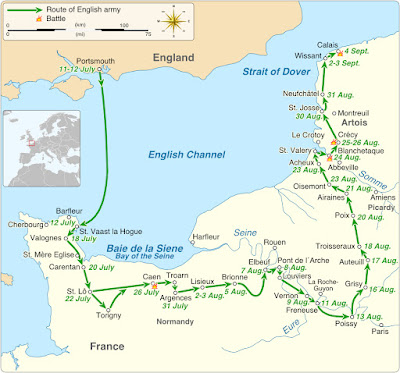
The Crécy campaign of 1346 is every bit a real historical campaign. On 12 July Edward III—who claimed to be the rightful king of France as well as England—landed 15,000 men on the Normandy beaches. It was his “medieval D-Day.” For the weeks that followed, his troops marched and burned and pillaged their way through Normandy, raiding cities and indulging in a chevauchée—a terror campaign designed to frighten and intimidate French people and to disillusion them with their leaders. (This is exactly the same tactical approach to warfare that Vladimir Putin adopted in the first weeks of the recent invasion of Ukraine.) The English came within a few miles of Paris, before forcing a crossing of the river Seine and then heading north towards the Somme, now pursued by a hastily assembled but very large French army. The two armies collided near the Forest of Crécy in late August. It was a spectacular battle with an improbable outcome.


So that much is known. But the historical accounts we have for these events are mostly written either by royal/noble/clerical/knightly participants in the war; or else by chroniclers sympathetic to such a class of people and interested in the ideals of chivalry rather than the “ordinary” experience. It would be impossible to write a straight nonfiction book about the adventures of a medieval Easy Company—such as the Essex Dogs are—because there are no soldiers’ diaries from this age. That’s why I chose fiction and elected in my approach to invent an imaginary “platoon” but have them interact with real historical characters such as King Edward, his son the Black Prince, the earls of Warwick and Northampton, and so on. It’s a similar approach to that adopted by one of my favourite American writers of historical fiction, James Ellroy. Think of American Tabloid: the three viewpoint characters are running blind through history, running into grotesque imagined versions of the Kennedy brothers, J. Edgar Hoover, Jimmy Hoffa, Howard Hughes, etc., etc. My Essex Dogs do exactly that, only in the white heat of a war for medieval France.

What was your process for weaving together fact and fiction? How did you create dialog and what research and sources were involved? Did you learn anything new or come across something that surprised you?

Well, as I’ve hinted above, all the plot points in Essex Dogs are real. I’ve pulled them from the sources of the time, which I know pretty well: we’re talking chronicles, letters, administrative records, and such. At the start of each chapter I’ve inserted snippet quotes from those sources to show you how fact and fiction intersect. But the Essex Dogs, my imaginary platoon, come at the events from a perspective not seen/cared about by the men who wrote those original sources. So there are many times when, in exploring the ordinary soldier’s view of events, my chapters run deliberate counterpoint to the official history. That also means there are a ton of Easter Eggs and jokes hidden in the text for aficionados who know their medieval history. (It doesn’t matter if you don’t spot them, it won’t spoil the read.)

As for dialog, that’s a really interesting point. There is no way to accurately mimic fourteenth-century speech on the page and remain intelligible to approx. 99.89% of modern readers. I also loathe the affected “Hollywood” rendering of “ye olde” dialog, which is about weird passive verb structures, phoney formality, and vaguely archaic vocabulary. For example, “be not troubled, my liege, the French want not this fight, I warrant.” Ugh. Gross. And lame.

I approached this as a translation task. Dialog in Essex Dogs is blunt, modern, often bracingly military and somewhat profane. The main concession I’ve made to fourteenth-century manners of speech is to include a colourful repertoire of high blasphemy—for in the later Middle Ages, cursing was done by references to God’s wounds or St Anthony’s bloody toenail, rather than leaning on scatology and urology. I had a ton of fun doing that. A TON. Maybe too much. You will have to be the judge.

Which characters did you enjoy writing the most and why? Which parts of the novel were the most challenging to write?

In light of the above, the earl of Northampton was my favourite. He’s the one noble character in the book who speaks a language the “grunts” can understand. Think General Patton’s speech to the Third Army in 1944, and you’ve got the general idea. When we first meet Northampton, he seems to be quite an atrocious individual because he doesn’t sugar-soap his speech like the other nobles do. Yet as the story goes on we learn that this man, the constable of the army (therefore roughly the fourth in chain of command), is the only one who can really communicate—and even sympathise—with the ordinary troops. And he’s prepared to put himself in harm’s way to lead them. I kind of love the guy, and I definitely lit up whenever he walked into a scene.

That being said, Northampton is not one of the Essex Dogs, and they were obviously my viewpoint characters. I spent most time living inside the head of Loveday, the leader, who is nursing a lost love and a lost brother-in-arms. Loveday consistently conveys the deeper themes of the book that transcend the period—about loyalty and regret, about the uncomfortable conflict between what you might call toxic masculinity and the deep-rooted male urge to be a good role model—a heroic father-figure and a brother. So he’s very dear to me. So too is Romford, the sixteen-year old, very damaged, very abused, a fiend and an addict, a sexually uncertain teenager figuring out a brutal world, but also at times just a tender little boy. Romford was the one who made me cry. When I was writing the last three chapters of the book I cried so much I almost shorted out the electronics on my laptop. Romford did that.

What are some of your favorite historical novels, and what about them do you find appealing?

Well, I mentioned Ellroy already. His American Underworld trilogy (American Tabloid, The Cold Six Thousand, Blood’s A Rover) made a huge impression on me when I read it—it was a different sort of historical fiction than I’d seen before. Don Delillo’s Libra I guess kind of the same thing. I love Mary Renault’s visions of the Bronze Age world—her book The King Must Die took the Minotaur story and told it like nothing I’d ever known. Of course, right now there’s a really interesting creative moment around the Middle Ages, particularly among American writers, who I suppose are drawn to previous ages of great change when it felt like DOOM was coming down the line pretty fast. Lauren Groff’s Matrix and Otessa Moshfegh’s Lapvona impressed me. Then, of course, there are the medieval big guns. Bernard Cornwell has given me some great advice on the couple of occasions we’ve spoken, and I think his work is sensational. I’m a big admirer of Ken Follett. George RR Martin—goes without saying. What connects them all? World-building. Heart. Thrills. Ideas.


Essex Dogs is the first novel in a trilogy on the Hundred Years’ War. What do you have in mind for the other two novels?

Volume 2 is called Wolf Moon. It follows continuous from Essex Dogs. Only now, rather than marching into the unknown, the Dogs find themselves caught up in the siege of Calais—a brutal eleven-month blockade of a small port on the French coast.

Why are they there? Why does the king care so much about taking it? What are they really fighting for? All this will be revealed as in Wolf Moon we peel back another layer of the war and discover who really wants it to last for a hundred years.

Wolf Moon is about money, merchants, and the medieval “deep state,” which cares nothing for chivalry or the loyalty to kings, only about the naked pursuit of power and profit. We will travel inside and outside Calais, from the siege city built outside the walls, to the pirate ships patrolling the harbour, and into the dark corners of oligarchs’ houses, where the deals that shape—and end—lives are made.

And at the end, we hear the first, faint, chesty rattle of a natural disaster that is sweeping towards the Dogs and their world—and which will set the stage for the epic third book in the series, The Last Knight.

When can we expect your next nonfiction book and what will you be taking on?

I’m writing a biography of Henry V. It’s the missing link between my big chronicles of medieval England: The Plantagenets and The Wars of the Roses. It’s a huge project and a challenge. But that’s the way I like it.


Images: Miniature of Edward III granting Aquitaine to his son, Edward the Black Prince, and of the Battle of Crécy from the Chronicles of Jean de Froissart public domain via Wikimedia Commons; map of Edward III’s chevauchée in Normandy in 1346 CC-BY SA 4.0 Goran tek-an, via Wikimedia Commons.

Friday, February 10, 2023

The Other Side of the Desk

One of the perks of having hosted New Books in Historical Fiction for more than ten years—as long as I’ve been publishing novels, although both twists along the road of life seem like turns I took yesterday, not in 2012—is that once in a while I get to shift gears and talk with one of the other hosts about a new book of my own. With Song of the Storyteller officially released as of January 17, the time has come to let the world know of its existence. G.P. (Galit) Gottlieb, the host of New Books in Literature and the author of three charming contemporary novels collectively known as the Whipped & Sipped Mysteries, offered to conduct this interview. It went live just before January gave way to February, and you can find the results at both the New Books Network (NBN) and various podcast subscription services such as Spotify and Apple Podcasts.

This isn’t my first interview for the New Books Network. I previously talked with Joan Schweighardt about The Swan Princess and with Galit about Song of the Siren and Song of the Sisters. You can find those previous conversations, if you’re interested, by searching for C. P. Lesley on the NBN site. Each time, I gain more insight into how my guests may feel when it’s their turn at the far side of the microphone—or, more often, just the receiving end of a telephone call. As I’ve mentioned elsewhere, I was shy as a teenager, and although I thought I had conquered that particular source of anxiety, my first forays into podcasting terrified me.

That was 140 or so interviews ago, and I have long since learned to take the host position in stride. But I was surprised by how nervous being a guest still makes me. That was especially true this time, because it was my first wholly unscripted conversation: I had no idea what Galit would want to know. And like many historians, I tend to ramble, so I worried that I would go down a conversational rabbit hole and emerge twenty minutes later to the online equivalent of glazed eyes.

Of course, none of that happened. Long before we actually started recording, I had relaxed into chat mode. Galit was as delightful as ever; she asked wonderful questions, and I mostly managed to rein my naturally discursive tendencies while answering. I didn’t say everything as perfectly as I would have liked, or tip my hat to every nuance, and I hem and haw more than I would have thought possible. But I did manage to get at least a few big points across. And the next time a guest forgets what she meant to say or tells me how nervous she is, I will be able to extend my condolences and assure her that I know exactly what she’s going through.

Galit and I talk mostly about the historical backdrop of the novels: the boyar politics, the religious differences, the bride show itself, a few of our favorite characters, what’s next for the series. So whether you listen to the interview first (you can find it at the link above) or read the book and then listen, I hope you’ll enjoy them both for different reasons.

You’ll also find out a little more about me, my background outside fiction, how I came to write these novels, and why I use a pen name to do so.

Galit’s latest novel, by the way, is due out later this month, and I will be interviewing her not long after the release. You can find out more about Charred and the series of which it is a part at her publisher’s website. At the moment, e-book editions of both the first book and the third are discounted.


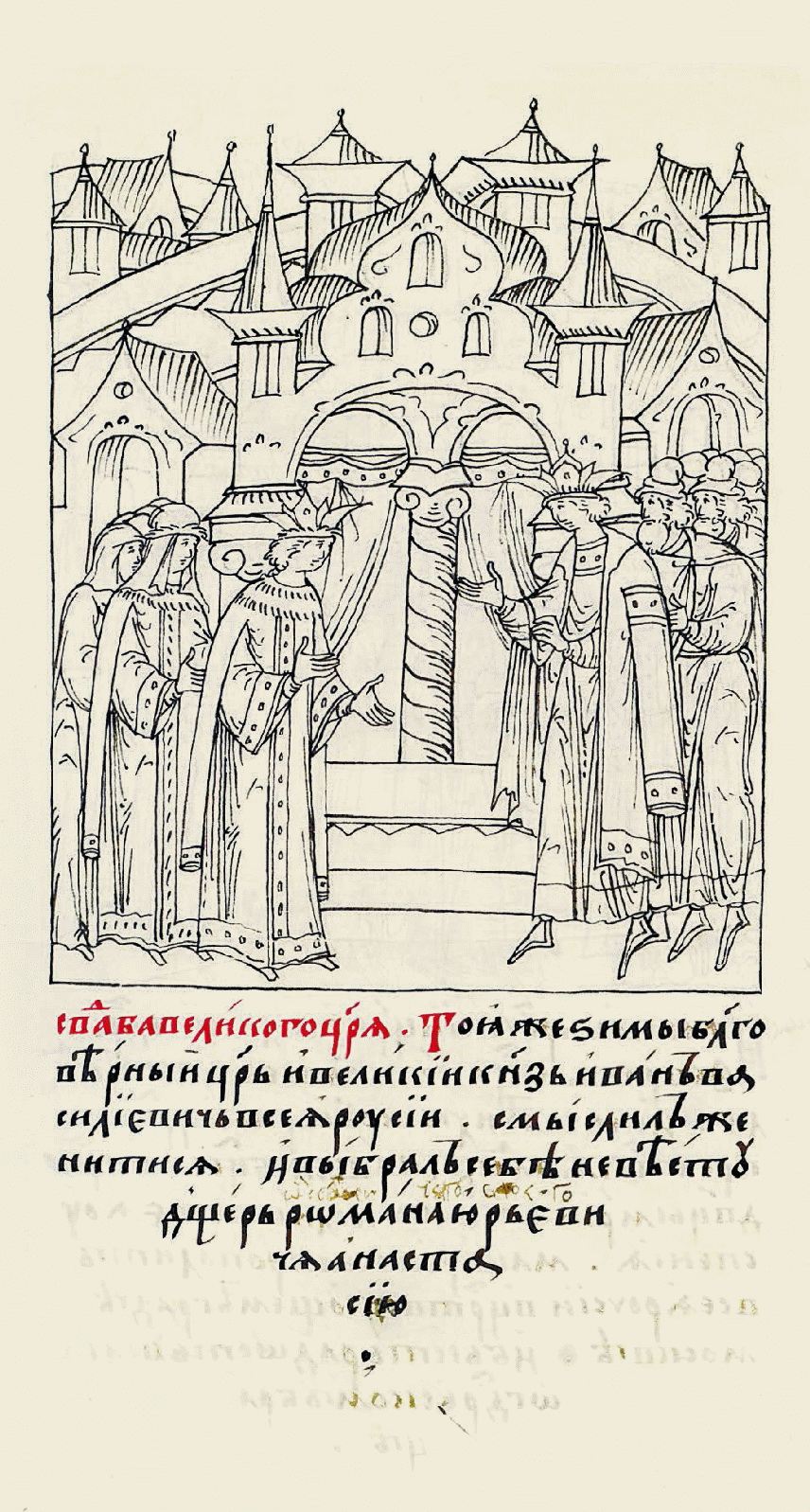
Image: Song of the Storyteller ad © C. P. Lesley; Ivan IV’s first bride show, from the 16th-century Illustrated Chronicle Codex (Litsevoi letopisnyi svod), public domain via Wikimedia Commons; covers for G. P. Gottlieb’s novels © D. X. Varos, reproduced under the fair use doctrine.

Friday, December 16, 2022

Moving Forward

Just about two weeks from now, I will press the button that officially releases my latest Russian novel, Song of the Storyteller, into the world. The book has been ready for a month, but I learned the hard way that late November/early December is not a good time to publish something new. The demands of Christmas shopping slow everything to a crawl, and even purchasing author copies can take five times as long as normal. Not to mention that the general flood of new releases tends to overwhelm those of us who don’t have the luxury of a big publisher with a fully staffed publicity department at our backs.

No, January—when people have recovered from the holiday madness, perhaps received e-devices of some kind as presents, and (at least in my part of the world) are looking at months of chilly days and long, dark evenings—is a much better time to launch a new book. So this post is a prequel of things to come, not an actual announcement.

Some books are fun to write: they flow like mountain water from the fingers onto the screen; their characters cooperate with interesting takes on things and problems that anyone can relate to, naturally sharing their views with the author because that’s who they are. Other novels have to be hauled, howling and protesting (or, more often, squirreling their secrets away like so many October hazelnuts), into the light.

I’ve had a couple of the latter in this series, as well as some of the former. Juliana (Song of the Siren) was desperate to tell her story; I could barely keep up with the flood of information she poured into my head from morning to night. Grusha (Song of the Shaman) and Darya (Song of the Sisters) were the shy sort; for different reasons, it took me a long time to find the strength at the center of each of them and coax it out to a place where I could see it. Solomonida (Song of the Sinner) had a strong character from the beginning, as well as an interesting problem, but complicating her situation enough to create a compelling story took a lot of work.
 

Then came Lyuba: Lyuba the storyteller, the natural, the heroine I’ve always dreamed of writing. Self-aware even at sixteen, with a fiery temperament offset by her sharp observation of others and of social convention, Lyuba is determined to wrest what she wants from life in the same way as she plots her fairy tales and takes mental notes for the family saga that we know from The Shattered Drum she will one day write. And the situation she faces is both historically real (except for her part in it, of course) and tailor-made for fiction.


In December 1546, Grand Prince Ivan of Russia (soon to be known as Tsar Ivan the Terrible) decided to marry. He too was sixteen, and for various reasons it was decided that he would select a bride from among his own aristocracy rather than make a diplomatic marriage with a foreign princess. A call went out to all the principalities under Moscow’s control, demanding the nobles present their daughters to the government servitors sent to the provincial towns to make the initial selection. Those girls (we don’t know how many), as well as others representing the great Moscow families, were investigated and gradually winnowed to a small group, from whom Ivan selected a bride. Anyone who has read any of my previous Russian novels can guess that Lyuba’s father would leap at this opportunity like a man-sized salmon.

The summoning of potential brides in itself was not uncommon. Ivan’s father had held such a bride show twice, and later tsars continued the practice until Peter the Great abolished it in the eighteenth century as too medieval and Russian. But what makes it perfect for fiction is that the families who got their girls into the contest took it with deadly seriousness—and I do mean deadly. Candidates were poisoned, girls suddenly developed mysterious ailments that lasted just long enough for them to be given the boot, skeletons were dragged out of closets and shoved back into them. Lyuba and her best friend, Anna, are right to wonder if they will make it out of the Kremlin alive.

And they don’t want any part of the contest. Each of them is in love with a young man she cannot have, and neither has any interest in becoming Russia’s first tsaritsa. And if that seems strange, in a world where so many young girls dream of becoming princesses, well, really, would you want to be the wife of Ivan the Terrible?

I should note that while I was working on the final revisions for this novel, Russia launched its unprovoked invasion of Ukraine. As I write this post, that war continues, and for those of us who have spent our adult lives studying the long and complex history of that region, it feels as if the world has shifted on its axis. Given Russia’s current status as an international pariah, even to write sympathetically about the country’s past in a novel is a source of confusion and doubt. The tragedy of lives lost, infrastructure destroyed, childhoods fractured, injuries inflicted, cold and hunger endured makes Lyuba’s struggles trivial.

But I also know that many Russians are equally horrified by the actions of their government—indeed, many Russians have Ukrainian family members. And that is why I nonetheless hope that my fiction can, if nothing else, reveal some of the political assumptions, historical realities, and beliefs about Russia’s place in the world that continue, even five centuries later, to influence its actions.

Among other things, those actions are based on the lie that Ukraine is, and always has been, a part of Russia. The same justification was given for the annexation of Crimea. But my novels take place at a time when neither Crimea nor Ukraine was considered part of Muscovy. Perhaps that is one contribution they can make to the discussion.

You can find out more about Lyuba’s story at https://www.fivedirectionspress.com/song-of-the-storyteller. Meanwhile, I will be returning my fictional focus to Anna, the center of the next novel and, alas, another of those heroines who requires a gentle touch and lots of patience if she’s to find her way into the light.

Image: Grigory Sedov, Tsar Alexei Choosing a Bride (1882), public domain via Wikimedia Commons.

Friday, December 9, 2022

Money, Beauty, and the Power of Music

I had heard of C. W. Gortner as a writer of Tudor-era historical fiction long before I actually had the opportunity to read one of his books. That one, The Romanov Empress, had nothing to do with the Tudors (Gortner, who has a Master’s in Renaissance history, had long since moved on from the sixteenth century) and everything to do with my other great academic love: the history of Russia and the Soviet Union more generally. But by the time I read it, I had already agreed to let Jennifer Eremeeva have the fun of interviewing Gortner for the New Books Network.

Fast-forward a couple of years, and I received a pitch for his next book, The First Actress, about Sarah Bernhardt. The novel—more or less contemporaneous with The Romanov Empress, which focuses on Marie Fyodorovna, the Danish princess who became the mother of Nicholas II—arrived at another moment when I had no space in my interviewing schedule, but we set up a written Q&A for this blog. So when I received a message from this year’s publicist about the release of Gortner’s The American Adventuress—featuring Jennie Jerome, the mother of Winston Churchill—I was determined to move heaven and earth, if need be, to talk to Gortner for New Books in Historical Fiction. That interview went live yesterday. It was a fun conversation, very revealing about Jennie and her world, and the novel is already in print, so give it a listen and then read the book. It’s the perfect time of year, after all, to dive into an enchanting saga about glittering society parties, royal liaisons, and aristocratic scandals that can show up even The Crown.

The rest of this post comes from New Books in Historical Fiction.

From Lucrezia Borgia to Marlene Dietrich, Empress Marie Fyodorovna of Russia, and most recently the actress Sarah Bernhardt, C. W. Gortner has made a career out of finding strong, fascinating, real-life heroines for his novels. In The American Adventuress, he focuses his attention on Jennie Jerome, the mother of Winston Churchill.

From the moment we first meet her as a sassy and defiant twelve-year-old schoolgirl, Jennie charts her own course—to the consternation of her more conventional but in some ways wiser mother. Her father—an entrepreneur hovering on the edge of elite New York society—adores and supports this second daughter whose character so resembles his own, but some shady business dealings and a long-term affair with Jennie’s piano teacher eventually undermine his marriage. Jennie’s mother flees with her three daughters to Paris, where the girls complete their education. Then the Franco-Prussian War begins, and the family moves to London and safety.


There Jennie makes the acquaintance of an odd-looking but charming and intelligent young man, Lord Randolph Churchill, who proposes marriage almost right away. Jennie falls madly in love, and soon they are courting in earnest despite opposition from both their families.


A gifted pianist, a beauty, a free spirit, and a loving if often-distant mother, Jennie lives life to the hilt: spending extravagantly, flirting outrageously, neglecting her children, and breaking convention in ways that defy our views of the constraints placed on Victorian women. But whatever her faults, Jennie herself is unforgettable, and it is Gortner’s achievement that he brings her so vividly to life.

Images: Jennie Jerome in 1880, with her two sisters, and with Lord Randolph Churchill in 1874—all public domain via Wikimedia Commons.

Friday, October 7, 2022

The Glory Days of Hollywood

As you can probably tell from all the book-related posts, I am, first and foremost, a reader. I enjoy movies, and there are even films I love and watch over and over, but I tend not to read reviews and I certainly haven’t spent a lot of time thinking about the early days of Hollywood. On the contrary, most of the little I do know comes, paradoxically but predictably, from novels such as Joy Lanzendorfer’s Right Back Where We Started From, featured on this blog in July 2021.

I was interested, though, when Graydon House proposed Bárbara Mujica’s Miss del Río for a New Books Network interview. The star here is not only a Hollywood actress but part of the Mexican community of actors who left their homeland to make their careers in Los Angeles in the 1910s and 1920s. Moreover, having fought to break out of clichéd starlet roles, del Río then went back to Mexico and played a role in the establishment of that country’s film industry. And that’s just the fictionalized real-life story. Another, wholly fictionalized mirror story proved to be even more compelling. Read on to find out more.

As usual, the rest of this post comes from New Books in Historical Fiction.


Miss del Río
explores the biography of a real-life actress, Dolores del Río, who became a silent movie star in Hollywood, navigated the transition to talkies, and eventually played a role in the establishment of the film industry in her home country of Mexico. The story plays out against the backdrop of the Mexican Revolution, which influences the lives of the characters in ways both direct and subtle. Add to all this a dramatic tale of the fictional María Amparo (Mara)—Dolores’s hairdresser, confidante, and wry chronicler—and you have a novel that breaks new ground in interesting ways.

The novel opens with Mara late in life, remembering a friend whose commemoration Mara herself is too old and frail to attend. From there, we move back to the outbreak of the Mexican revolution, with Mara a small child being dragged through the streets by her caretaker, a rough woman known as Tía Emi throughout the book. Through Mara’s eyes, we see her first encounter and budding relationship (whether it is truly friendship is an ongoing theme) with the child Dolores, whose background is very different from Mara’s.  Mujica then follows the lives of both women as they interact, overlap, and at times separate throughout Dolores’s career.

But Mara has a story of her own: to find out who her mother was, what happened to her, and how Tía Emi became Mara’s caretaker. It’s a tale even more compelling than Dolores’s fight to be taken seriously in her chosen career, and through it, Bárbara Mujica pulls us along to a dramatic finale and a satisfying conclusion.


Images: Dolores del Río in Joanna (1925), her first starring role, and with her mother (1930), both public domain via Wikimedia Commons.

Friday, May 27, 2022

When History and Fiction Intersect

Many thanks to Joan Schweighardt, who ran this interview with me on the Five Directions Press site today. Alas, three months after Russia’s invasion of Ukraine, the cross-linked post below is as relevant as it was the day it went up.
 
Your new novel is the fourth book in your Songs of Steppe & Forest series. Can you tell us something about the series as a whole and the newest title, Song of the Sinner, in particular?
 
The series as a whole explores the boundaries that constrict women’s lives in Tudor-contemporary Eastern Europe—specifically, Russia and the surrounding lands in the 1540s. Unlike my first historical series, where the main characters had arranged marriages—as most people did at the time—in this one I wanted to explore less traditional paths to happiness. These characters embrace love without marriage or emphasize their religious vocations or pursue lovers whom others consider unsuitable. Solomonida, the heroine in Song of the Sinner, strives to balance her love for a man from a lower social class against her belief that she should sacrifice her own needs on behalf of her daughter. Something a lot of contemporary mothers struggle with as well! She also fears that commitment means loss of control over her own fate and even her body, because her first husband was a manipulative brute.


Your Russian-based fiction is an extension of your academic career. Can you tell us the story of how you came to be a scholar regarding all things Russian.
 
I’ve always loved languages, and when I discovered that my northern New Jersey high school offered Russian, it sounded exotic and fun. So I signed on. When I got to college, I fell in love with the culture and the history—which is a long series of dramatic events worthy of the movies. So when I decided to apply to grad school in history, it made sense to focus on Russia. But I was always more interested in pre-industrial times; hence my specialization in early modern Europe, sixteenth-century Russia in particular. In addition to my novels, written under a pen name to separate them from the academic stuff, I translated and published The Domostroi: Rules for Russian Households under Ivan the Terrible, which is a set of instructions written (probably) in the sixteenth century on how to manage a large urban household, including everything from proper behavior in church to recipes and ways to keep the servants from stealing food and other household goods.
 
You recently wrote an essay titled The Tangled History of Russia and Ukraine. Which of your novels would you recommend to readers who want to further explore that history from a fictional perspective?
 
My novels portray a world where what is now Ukraine is firmly situated within the Polish-Lithuanian dual monarchy, as it was in the sixteenth century, revealing the falsehood of current statements that Ukraine is simply a Russian province with no history of its own. They also reveal principles of political life that, despite many changes over the centuries, still operate in today’s Russia—the preference for oligarchy, for example. And they do this in a lighthearted, non-preachy way. I would suggest readers start with The Golden Lynx, which sets the stage for the books that follow. The heroine of that series is a Tatar princess, sent to Moscow without adequate preparation, so she needs explanations of the workings of Russian society that also benefit the reader. The second novel in that series, The Winged Horse, offers a historically accurate view of Crimea very different from anything you might have seen in the news media eight years ago, when the Russians snatched it from Ukraine. (Coincidentally, Winged Horse came out in the spring of 2014, right after the annexation.) The hero of The Vermilion Bird and The Shattered Drum has also spent time in the steppes north of Crimea, in service to a renegade would-be khan.
 
The other book worth taking a look at in this connection is Song of the Siren, which begins in Renaissance Poland before moving eastward to Muscovy. The heroine of that book, Juliana Krasilska, is firmly convinced that Moscow is a backwater compared to Kraków. That’s not entirely fair, but it does give a clear sense of the separate cultural trajectories of Muscovite Russia and Ukraine, which spent several centuries under Polish influence.
 
Because you are a historian who has focused all her adult life on a particular part of the world through time, the reader can trust that the settings, clothes, food, weapons, etc. that your characters come into contact with are utterly historically accurate. What about the characters themselves? Do you attempt to get into the minds and hearts of the czars and other personages we might know? Or are they more or less part of the staging on which your fictional characters come alive?
 

I try to give historical characters the widest berth possible. As a historian, the idea of putting words into the heads and mouths of people who actually lived makes me squirm. It’s not always possible, however, to avoid historical personages entirely. In those cases, I do my best to keep their words in line with their known deeds and emphasize to my readers that we have almost no information about the personal lives of even the best-documented figures in sixteenth-century Russia. That includes Ivan the Terrible himself, although naturally we know more about what he did (or is supposed to have done) than we know about most of his subjects. So in that sense, yes, I restrict the real people to the background and let my fictional characters take center stage.


You have one more book to go in your Steppe & Forest series. Did you know in advance that this series would encompass five books?
 
I knew from the beginning that the first series, Legends of the Five Directions, would end with the fifth direction (Center). But this series is actually open-ended. I happen to be close to finishing book 5, but I’m working on the plot for book 6, Song of the Steadfast, and I have rough ideas for at least two more books beyond that. Those last two, if I get to them, will move into the 1550s. I can imagine as many as ten, but anything beyond Songs 8 is so hazy as to be almost invisible at this point.
 
Although Song of the Storyteller is a work in progress, can you tell us a bit about what to expect?
 
Absolutely. This may be my favorite of the whole series. Lyubov Koshkina, known as Lyuba, first appeared as a six-year-old in The Vermilion Bird, and at the end of that series, she informed me that she was the unnamed narrator of the Legends books as a whole. Here we encounter her just as she is finishing The Shattered Drum and considering what she will write next. She decides to tell her own story: her memories of when, as a sixteen-year-old girl, she was summoned to the first bride show held for Tsar Ivan the Terrible (think The Bachelor, but the prize is a royal crown, not a rose). Her father desperately wants her to win, but Lyuba has fallen in love with a dashing Tatar prince. Her job is to get herself dismissed from the bride show without insulting the tsar while dodging the dirty tricks sure to be played against her by various rivals and their families. And since her best friend, Anna, has also been summoned against her will, Lyuba has to find a way to fulfill her own goals without undermining her friend’s.


Do the novels in your historical series work as standalone reads?
 
They do, in the sense that I ensure you can pick up any one of them and know what’s going on without having to have read the preceding books. The historical novels are all connected, though, and people have told me that they benefited from knowing that minor characters in one book were central to earlier ones. Some readers also enjoy catching up with old friends. So if I’m asked, I suggest starting with either The Golden Lynx or Song of the Siren. If you like the first book in the series, then you’ll probably like the others as well.
 
Do you know yet what you will write next?
 
I’m three chapters into Song of the Steadfast, but I’m taking a break to work out the political background before moving forward. Each Songs of Steppe & Forest novel centers around a romance—in this case, Anna Kolycheva (Lyuba’s best friend, as mentioned above, and Solomonida’s daughter) and a young man named Yuri Vorontsov—but the books are not only romances. Here the political infighting is between the young tsar’s uncles and his recently acquired in-laws, played out against the backdrop of three devastating fires that struck Moscow between April and June 1547. Once I figure out exactly what happened and how I can fit my fictional characters into the history, I’ll get going again. I’ll also be rewriting parts of Song of the Storyteller this summer so that it feeds seamlessly into the sixth book.

Images: 17th-century depiction of Ivan the Terrible (r. 1533–1584); Konstantin Makovsky, The Tsar Chooses a Bride (1886), both public domain via Wikimedia Commons.


Friday, March 4, 2022

The Power of Family

In these troubled times, with Russia launching a military attack against neighboring Ukraine in a misguided attempt to restore—literally or figuratively—the Slavic portion of the old Soviet empire, it seems like a strange coincidence that my latest New Books in Historical Fiction interview explores the disintegration of that Soviet empire’s predecessor and the early days of Bolshevik power. But this is, in fact, part of the complex history of Russia’s relationship with its neighboring states and, more broadly, with Europe. So the subject of this novel, conceived at least two years ago, is more pertinent to the present than it may appear at first glance.

The history of the Russian Revolution, including the assassination of Emperor Nicholas II and his wife and children, has been so thoroughly researched that spoilers are not really possible. But what Bryn Turnbull does in The Last Grand Duchess is to focus in on the Romanovs as a family—their strengths and weaknesses, their conflicts and desires, and above all their deep and lasting devotion to one another even as events spin out of their control. Although elements of the story are fictional, as one would expect, Turnbull hews pretty close to the facts, and in doing so she both raises questions—suppose the daughters had married foreign princes before the revolution?—and offers explanations of otherwise troubling points in their history (why the emperor and empress did not send their children out of the country when that was still possible, for example).

Above all, she individualizes the five younger members of the family, who have at times been caricatured as the sick princeling Alexei and an undifferentiated OTMA, comprising the four daughters. She also manages to produce a balanced and convincing portrayal of Rasputin. So although you probably know how the story ends, read the novel anyway. And as we work our way through another episode of imperial overreach, you may even find it eerily prescient.

As usual, the rest of this post comes from the New Books Network.
 

Interest in the events leading up to the Russian Revolution of 1917 has only increased since the centenary of the Romanovs’ assassination in 1918. Bryn Turnbull tackles this familiar story from the perspective of Emperor Nicholas’s eldest daughter, Grand Duchess Olga Nikolaevna (1895–1918).

The novel opens with a prediction, made on the day of Olga’s birth, that the infant grand duchess would “not live to see thirty.” From there it moves to 1907, when the young heir to the throne, Tsarevich Alexei, is on the brink of death due to uncontrolled bleeding, the result of his hereditary hemophilia. Enter Grigori Rasputin, who enacts a miracle cure, saving the boy’s life and earning himself the undying gratitude of the desperate empress.

With this central conflict established—including the secrecy maintained around the nature of Alexei’s illness for as long as he remained heir to the throne—we shift forward in time to Nicholas II’s abdication in March 1917. The two stories of the revolution and the years that preceded it intertwine, with accounts of Olga at parties or nursing during World War I interspersed between chapters detailing the increasing confinement of the family after the revolution, from the Alexander Palace in Petrograd to a house in Siberia, then their transfer to the mansion in Ekaterinburg where the assassination took place.

Olga makes a compelling narrator, old enough to see what’s going on and have opinions about it but young enough to enjoy life, whether that means flirting at her coming-out party, chatting with a handsome wounded army officer, or riding a sled down Snow Mountain, a structure built by her and her siblings at the interim house in Tobol’sk. She is intensely family-focused, devoted to Russia, and charmingly naive due to her sheltered upbringing. Indeed, if one thing comes through in this richly described and thoughtful novel, it is the love of Nicholas II, his wife, and his children for one another—even if their insistence on staying together dooms them all.

Many factors, of course, lay behind the Russian Revolution, and The Last Grand Duchess hints at poverty, disillusionment, the massive casualties of the Great War, and Bolshevik determination as well as Nicholas’s limitations as a ruler, Alexandra’s shortcomings, Rasputin’s ambition, and the “ministerial leapfrog” to which those failings gave rise. But the strength of fiction lies in its ability to draw us into the minds and hearts of a small group of people, and in this case, that group is Olga and her immediate family. It’s a journey well worth taking.

Friday, February 25, 2022

Perils of an Empty Throne

I met Patrycja Podrazik, who writes under the name P.K. Adams, not long before the release of her second novel featuring the eleventh-century mystic, physician, and theologian Hildegard of Bingen. I have since interviewed her twice for the New Books Network, once on the Hildegard novels, and a second time for her historical mystery series set in sixteenth-century Poland. And if you’ve been following this blog, you’ll know that we have also co-written a historical mystery/suspense novel about the early interactions between Muscovy, the lands to its west, and the Tudor sailors who “discovered” Russia in 1553. So it’s a pleasure to welcome her today as my guest.

Adam’s Silent Water begins with the arrival of Caterina Sanseverino, a widowed Italian noblewoman, in Kraków in April 1518. Caterina is traveling with Queen Bona Sforza, on the route to her wedding with Poland’s King Zygmunt I. Fast forward to Christmas 1519, and Caterina, now established in her position at court, encounters a series of puzzling murders, and her resolution of the mystery leads to her recruitment for a difficult political task by Queen Bona during a later visit to the Polish capital in 1545. That task in turn pushes Caterina into investigating another set of deaths in Midnight Fire. By the time this third novel—Royal Heir, released two months ago—opens, Caterina is enjoying her old age in Italy, and her son takes center stage.

There is, of course, a particular irony in publishing this post a day after Russia’s invasion of Ukraine, an attack based on the pretext that Ukraine is no more than a breakaway province that needs to be reintegrated into the whole. Although the long complex history of Ukraine as part of the joint Polish-Lithuanian Kingdom is more visible in Midnight Fire than in this new novel, another century would pass before the Cossack rebellion that led to Ukraine’s request for Russian suzerainty.

And with that, I turn the virtual mike over to P.K. Adams, with thanks for sending me this post laying out the historical background of her Jagiellon Mysteries and why she decided to use this troubled political situation in writing Royal Heir. But do listen to the interviews to find out more about the series—and, of course, read the books!


An uncertain succession to the throne is a challenge familiar to monarchies throughout the ages. It has opened doors to ambitions, struggles, and acts of deception and violence that have cost lives, changed states’ borders, and sent their history on a new course. In fact, such is the dramatic potential of a vacant (or soon to be vacant) throne that it has inspired works of fiction for centuries, and, in more recent times, has given rise to enormously popular TV series and movies. 

How lucky, then, that a crisis of this kind unfolded in Poland-Lithuania in the second half of the sixteenth century, the period in which my series Jagiellon Mysteries is set. Lucky for me, that is, not for the state or the people who lived in it at the time. After nearly a century known as the Golden Age—most of it under the rule of the last two Jagiellon kings, Zygmunt I (the Old) and Zygmunt II August—Poland had reached the peak of its size and political influence. Its possessions stretched from the Baltic in the north to the shores of the Black Sea in the south. It had a vibrant artistic life influenced by the ideas of the Italian Renaissance. Polish scholars took degrees at western European universities, and foreign intellectuals flocked to study and debate at the Cracow Academy (now Jagiellonian University).

However, by the 1560s, dark clouds began to gather on the horizon. The long-standing conflict between Zygmunt August and the powerful noble class had hamstrung the administrative and judicial reforms needed to strengthen the state. Moreover, after the premature death of his beloved second wife, Barbara, the king contracted a loveless marriage to Catherine Habsburg that quickly fell apart, and with it vanished the hope for an heir. In his mid-forties, with flagging health and an increasing lack of interest in the affairs of state, the king no longer guaranteed the stability of his kingdom. Still, while he was alive, Poland-Lithuania could consider itself reasonably secure from outside threats. One can only imagine, however, the anxiety with which magnates, officials, and ordinary men and women thought about the inevitable moment when the throne became vacant and powerful neighbors—the Habsburgs, in particular—reached for the trophy that was the crown of the dual monarchy.

When I considered ideas for the third book in the Jagiellon Mystery series, telling a story tied to the uncertain succession seemed like a no brainer. Although there is no historical record of an assassination plot, the last decade of Zygmunt August’s life (he died in 1572) must have been rife with scheming and planning for what would happen if he failed to produce a legitimate heir. The drama would only have been heightened by the king’s increasingly reckless personal life, especially as contrasted with that of his God-fearing sister (and heir presumptive) Princess Anna. Zygmunt’s sexual exploits in that period became legendary and included the kidnapping and seducing of one of Anna’s own ladies-in-waiting. He also embarked on a scandalous affair with the daughter of a bourgeois Warsaw family, which resulted in the birth of a child. Of course, there could have been no question of the succession passing on to a baby who was born out of wedlock and whose paternity, although strongly suspected, could not be established beyond any doubt precisely because her parents were not married.

The plot of Royal Heir, which is set in the autumn of 1563, revolves around an attempt by a group of disgruntled noblemen to force Zygmunt August to abdicate so they can elevate his half-brother to the throne. The protagonist, who in this novel is Caterina’s son Julian Konarski, accidentally stumbles onto the scheme when he witnesses the fatal beating of a young man in a dark alley in one of Kraków’s less savory neighborhoods. But when he begins to dig deeper, the details of the plot fail to add up: Zygmunt August’s only half-brother (and an illegitimate one at that) died years ago, and an eavesdropping session conducted in the plotters’ lair reveals that their plans toward the king may be far less gentle than mere abdication.

Prompted by his youthful idealism, Julian begins a desperate race to a stop an act of regicide and avert a coup d’état. His love interest, Magda, bravely aids him in his quest, but by the time they realize the formidable nature of those they are up against, their lives, too, are in terrible danger.

P.K. Adams is the author of The Greenest Branch and The Column of Burning Spices, a pair of novels about the life of Hildegard of Bingen, and of the Jagiellon Mysteries. Find out more about her at https://www.pkadams-author.com.


Friday, January 14, 2022

Gulag Ballerina

On February 2, 1938—late at night, as was the custom—the Soviet police, then known as the NKVD, arrested a suspected German spy in Leningrad. Stalin’s Great Terror was well underway, meeting arbitrary targets set from the center the previous summer: 268,950 arrests, which should lead to 72,950 shootings and 196,000 prison sentences (8–10 years each) within four months. The specificity of the numbers is itself astonishing, not least because it emphasizes the state’s complete disinterest in the guilt or innocence of the accused.

In this case, the person arrested was Nina Anisimova, an acclaimed character dancer and budding choreographer at the Kirov Ballet. She was one of several dancers investigated for past contacts with one Evgeny Salomé, the legal consultant to the German consulate in Leningrad. Salomé, in turn, was a Soviet citizen of German extraction who appears to have been the kind of avid fan that Russians call a baletoman (ballet maniac). He liked to throw parties and invite the cultural elite of 1930s Leningrad, especially if they knew their way around a pointe shoe.

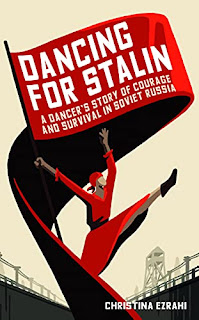
As Christina Ezrahi notes in her remarkable new book, Dancing for Stalin: A Dancer’s Story of Courage and Survival in Soviet Russia (London: Elliott & Thompson, 2021), there is no evidence that Salomé spied for the Germans. Still less is there any reason to suspect Anisimova of anything worse than knocking back a flute or two of champagne in the wrong company. She had even broken off contact with Salomé in 1934. But her arrest came during the height of persecution in Stalin’s Russia, and Anisimova spent months in detention, followed by a sentence of five years in a labor camp in Kazakhstan. She arrived at the transit camp in October 1938, after a nightmare journey aboard a cattle car, and narrowly escaped a further transit east.

So far, this is a tragic story but not, alas, an unusual one—as the records of the Memorial Society in St. Petersburg, so recently closed down on orders of the Russian government, make clear. But Anisimova’s story did not end there. Her husband, also an artist with the Kirov albeit not a dancer, bent heaven and earth to secure her release—risking his own life and freedom by lodging complaints at all levels of the political hierarchy. Seven months after Anisimova arrived in Kazakhstan—where, in a bizarre twist, she survived by dancing for her captors—her husband’s petition hit the right desk on the right day, and she was summoned back to Leningrad for a review of her sentence. By the end of September 1939, the NKVD had overturned her conviction, releasing her to return to the Kirov, where she continued to dance and to choreograph into her fifties (she was twenty-nine at the time of her arrest).

Life was not smooth sailing even then. In June 1941, Hitler invaded the Soviet Union. The Kirov was evacuated to Perm (Molotov, in those days), and Anisimova went with them. But thanks to poor timing and perhaps other factors, her husband and sister stayed behind, narrowly surviving the Siege of Leningrad and the famine that made the winter of 1941 hideous.

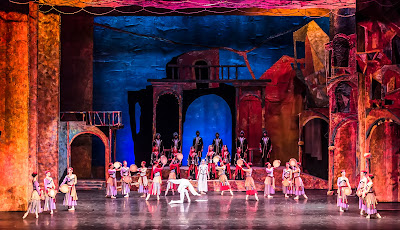
Meanwhile, in Perm, Anisimova began work on the ballet Gayané, her greatest triumph—performed to music by Aram Khachaturian and a libretto by her husband. Russian troupes still dance it, although it has never established a foothold in the West.


In the decades that followed her rehabilitation, the two years that Anisimova spent in detention were erased from her record. Ezrahi learned of them only through an archival file that landed on her desk by mistake. From there she pieced the story together.

This is, however, more than the story of one courageous and wrongly accused woman and her steadfast, loving husband. Through Ezrahi’s fluid and captivating prose, readers learn about Anisimova’s suffering but also about the realities of the Gulag; the cynicism of the mass arrests and repression; the Kazakh famine (like the better-known Ukrainian Holodomor, the result of poor state planning and malicious neglect); Soviet prejudice against anyone with ties, however weak, to the previous regime; and much more.

Although we regret and deplore the death and suffering of millions, it is the nature of the human brain to react most strongly to the plight of individuals. This is why reading fiction builds empathy: it draws us into someone else’s emotional experience. The best histories have the same kind of impact. Dancing for Stalin is that kind of book, and even if you’ve never tackled academic history before, give it a try. You’ll be glad you did.

Image: Modern performance of Gayané, © Karen Yan, Own Work, CC BY-SA 3.0 via Wikimedia Commons.

Friday, December 10, 2021

Swords into Plowshares

If asked to summarize in one word what ended the Napoleonic Wars, most people would say “Waterloo.” And indeed, the Battle of Waterloo, fought between Napoleon’s legions and the Allied troops under the leadership of Arthur Wellesley, Duke of Wellington, did wreak such havoc on the emperor’s reputation that it eventually brought to a close the ongoing conflict for supremacy between France and Great Britain, which had simmered throughout the previous century.

To say that Waterloo brought peace to Europe would be an exaggeration: conflicts within states continued, as did wars between Russia and Turkey and attacks by colonial powers on communities in other parts of the world. But between 1815 and the outbreak of World War I ninety-nine years later, Europe did not experience an all-continental war of the type launched by Napoleon Bonaparte.

Even so, as we can see from Bernard Cornwell’s Sharpe’s Assassin: Richard Sharpe and the Occupation of Paris, published by Harper in the United States this past Tuesday, Waterloo did not mark the actual end of the war so much as the beginning of the end. As Cornwell himself notes in his nonfiction book Waterloo: The History of Four Days, Three Armies, and Three Battles (New York: Harper, 2014, 316), although Napoleon may have lost 30,000 men during the battle on June 18, he estimated that he could field 300,000 a few days later. “All is not lost,” he wrote to his brother Joseph.

But it was, and this novel explores the reasons why. Sharpe’s Assassin follows Cornwell’s Richard Sharpe, the hero of more than twenty books and by now advanced to the rank of Lieutenant-Colonel, from Waterloo to Paris. Sharpe’s job is first to free an English spy being held in the town of Ham, then keep that spy safe as they travel to Paris, full of sullen citizens who still support the emperor (the return of the Bourbons in the form of King Louis XVIII pleases no one in this book) but are tired of fighting for him. Yet a small (fictional) secret group of loyalists known as La Fraternité (the Brotherhood) has sworn to protect Bonaparte in life and avenge him in death or defeat. Does the group exist in fact as well as in name? Does it really plan to assassinate the Allied leaders, starting with Wellington? Can Sharpe discover the members in time to prevent any such plot? And what will Sharpe himself do once the war that has consumed so much of his adult life finally staggers to its end?

Although the Sharpe series is Cornwell’s longest-running, the previous installment appeared in 2007. In the interim, we have made the acquaintance of Uhtred of Bebbanburg, the Saxon lord raised by Danes and adamant rejector of Christianity as a proper faith for warriors. Lord Uhtred has become the star of thirteen novels and a hit Netflix TV series, The Last Kingdom, now entering its fifth (and final) season. For those—like me—who first encountered Cornwell’s work through Uhtred, two things about this latest novel are important to know. First, you need not have read any of the previous Sharpe books to enjoy this one. Selected parts of the hero’s past are presented as needed, and the whole is easy to follow.

Second, Sharpe is not Uhtred, but he does resemble Uhtred in certain ways that should appeal to readers of the Last Kingdom series. Sharpe goes his own way, whatever orders he receives from the military brass. He has risen through the ranks from a disadvantaged background, making him both prickly about being given the respect he deserves and fiercely loyal to his men (most of whom come from the same social class that he does) and strong in their defense. He is smart and experienced, a man who fights hard when fighting becomes necessary but doesn’t embrace violence for its own sake.

Sharpe doesn’t quite have the complexity of Uhtred, the split loyalties that force the Saxon lord into constantly questioning what matters to him most. That makes Sharpe a little less interesting to someone like me, who skims through the war scenes in search of interpersonal conflicts and development. But Sharpe has his friends and foes, his loves and losses, his own version of split loyalties more appropriate to the early nineteenth century, which draw readers into his story. And the writers among us will appreciate Cornwell’s note at the end, where he mentions that Sharpe got to pick his own ending, which proved as much a surprise to the author as it perhaps does to the character. Sharpe’s story may not yet be over, but it does come to a place of rest—and the war-torn nations of Europe find a respite from their struggles as well.


Image: Jan Willem Pienamen, The Battle of Waterloo (1824), showing the hatless Duke of Wellington mounted in the center and the wounded Prince of Orange being carried from the field in the left foreground (an incident attributed to Sharpe in the novel)—public domain via Wikimedia Commons.