Pages

Friday, October 14, 2022

Christmas in October

Many people have heard of Christmas in July, a neat bookend to the traditional December holiday. But for the commercial publishing industry, Christmas starts in October. That’s when holiday-themed titles begin to be released in time for early-bird shoppers—or at least in the hope of establishing enough buzz to generate sales.

My first comment is that things seem to be getting off to a slow start this year. In 2021 at this time, I had at least twice as many feel-good Christmas books on my bookshelf and my phone. This year, I have beautifully written novels releasing in late fall and early winter—Nicola Cornick’s The Winter Garden, for example—but only two that explicitly reference the holidays. A delayed effect of the pandemic, maybe? The last few years haven’t exactly been sunny and bright.

But that said, here’s a quick look at the Christmas-connected books that have crossed my desk so far—with hopes there may yet be more to come.


Vanessa Kelly, The Highlander’s Holiday Wife (Zebra Books, 2022)
This latest addition to the author’s Clan Kendrick series pairs Braden Kendrick, a doctor set on working among Edinburgh’s considerable slums, and Lady Samantha Penwith, a young widow set on avenging her husband’s death—a quest that takes her, dressed as a man, to the same murky areas of the city. It’s November 1826 when Braden runs into trouble in a dark alley and Samantha rescues him. Of course, he has no idea who she is, but he makes it his mission to find out. Hers, naturally, is to elude pursuit.

Braden is a good-hearted and appealing hero, although to me Samantha is the more complicated and therefore the more interesting half of the prospective couple. But lovers of historical romance will revel in this fast-moving tale with its exploration of the highs and lows of Scottish society under King George IV and its snappy dialogue. By the time you reach the end, you will not only be rooting for Braden and Samantha to get together but will also feel quite ready for fir trees, Hanukah candles, presents, and anything else you normally do to celebrate the great turn of the Earth and the prospect of more sunlight for the next six months.

Bonnie MacBird, What Child Is This? (Collins Crime Club, 2022)
If you haven’t already encountered Bonnie MacBird’s take on Sherlock Holmes (Art in the Blood, Unquiet Spirits, The Devil’s Due, and The Three Locks), I wholeheartedly recommend them. I had a great time interviewing her last year about the series for the New Books Network, and I was impressed by how well she balances respect for the Holmes canon with her own take on the characters.

What Child Is This? follows through in both respects. Specifically labeled as a Christmas Adventure, it includes delightful illustrations by Frank Cho. In short, the premise is as follows: Holmes, perhaps unsurprisingly, adopts a gloomy stance toward Christmas, eschewing all forms of holiday glee. Watson, also running true to character, loves every snowflake and strand of tinsel. As the two of them stroll down a London street—one complaining, the other filled with seasonal joy—they interrupt an ongoing kidnapping, restoring the child to his mother.

Shortly thereafter, Holmes gets a new commission: to find a marquis’s missing son. He accepts, to pass the time until the world stops celebrating, but his interest lies more with the kidnapping: what lay behind it, whether the villain will make another attempt, and how to protect the innocent child, who was born on Christmas Day and bears a birthmark resembling the Star of Bethlehem.

How these two cases intertwine—or don’t—makes for a delightful and ultimately touching read, one that at 225 pages can easily be fitted in around bouts of shopping and preparations for entertaining family and friends.

For the other, non-holiday-themed titles on my bookshelf, check back toward the end of the month. Next week is reserved for a forthcoming change to my household (hint below). More on that soon.


Friday, October 7, 2022

The Glory Days of Hollywood

As you can probably tell from all the book-related posts, I am, first and foremost, a reader. I enjoy movies, and there are even films I love and watch over and over, but I tend not to read reviews and I certainly haven’t spent a lot of time thinking about the early days of Hollywood. On the contrary, most of the little I do know comes, paradoxically but predictably, from novels such as Joy Lanzendorfer’s Right Back Where We Started From, featured on this blog in July 2021.

I was interested, though, when Graydon House proposed Bárbara Mujica’s Miss del Río for a New Books Network interview. The star here is not only a Hollywood actress but part of the Mexican community of actors who left their homeland to make their careers in Los Angeles in the 1910s and 1920s. Moreover, having fought to break out of clichéd starlet roles, del Río then went back to Mexico and played a role in the establishment of that country’s film industry. And that’s just the fictionalized real-life story. Another, wholly fictionalized mirror story proved to be even more compelling. Read on to find out more.

As usual, the rest of this post comes from New Books in Historical Fiction.


Miss del Río
explores the biography of a real-life actress, Dolores del Río, who became a silent movie star in Hollywood, navigated the transition to talkies, and eventually played a role in the establishment of the film industry in her home country of Mexico. The story plays out against the backdrop of the Mexican Revolution, which influences the lives of the characters in ways both direct and subtle. Add to all this a dramatic tale of the fictional María Amparo (Mara)—Dolores’s hairdresser, confidante, and wry chronicler—and you have a novel that breaks new ground in interesting ways.

The novel opens with Mara late in life, remembering a friend whose commemoration Mara herself is too old and frail to attend. From there, we move back to the outbreak of the Mexican revolution, with Mara a small child being dragged through the streets by her caretaker, a rough woman known as Tía Emi throughout the book. Through Mara’s eyes, we see her first encounter and budding relationship (whether it is truly friendship is an ongoing theme) with the child Dolores, whose background is very different from Mara’s.  Mujica then follows the lives of both women as they interact, overlap, and at times separate throughout Dolores’s career.

But Mara has a story of her own: to find out who her mother was, what happened to her, and how Tía Emi became Mara’s caretaker. It’s a tale even more compelling than Dolores’s fight to be taken seriously in her chosen career, and through it, Bárbara Mujica pulls us along to a dramatic finale and a satisfying conclusion.


Images: Dolores del Río in Joanna (1925), her first starring role, and with her mother (1930), both public domain via Wikimedia Commons.

Friday, September 30, 2022

Wrexford and Sloane Return

As noted earlier, I love Andrea Penrose’s Wrexford & Sloane series—also her ongoing Lady Arianna Hadley series, which has some interesting overlaps in terms of characters with Wrexford & Sloane (on which, more below). I interviewed the author last year when Murder at the Botanic Gardens came out. You can find out quite a bit about the main characters and their relationships, as well as the Napoleonic/Regency background of both series, by listening to that interview. You can also find out more about series, author, and background at http://andreapenrose.com.

One thing that sets the series apart, in addition to fascinatingly complex characters and richly and often beautifully described settings, is that each novel explores a scientific development that began during the English Regency and still influences our world. In this case, that invention involves military technology. I can’t say more because discovering exactly what the invention is and what happened to the plans for it consumes the first half of the book. But I will say that the invention, were it to succeed, would give whatever country controlled it a distinct advantage over its enemies. At a moment when Napoleon appears to have finally been defeated and sent to exile on Elba, the possibility that said invention could fall into the hands of the French has all the Allied Powers sweating. Most of them don’t trust each other any more than they do the French, which has them all at one another’s throats. That we know Napoleon won’t be on Elba for long (even though the characters don’t) just ups the ante.

Fans of Penrose’s other Regency series featuring Lady Arianna will be happy to see the arrival of Lord Grentham, the mysterious and ruthless minister of state security, with this novel. Charlotte Sloane’s two urchins also make a new friend, and Wrexford and Sloane’s partnership continues to develop, as do certain other relationships. But this installment is not just a worthy addition to the series; it is my favorite so far. The only downside of getting my hands on it early is that I’ll have to wait even longer for the next one. But Murder at the Serpentine Bridge is out as of this Tuesday, so you don’t have to wait.

In the absence of greater detail of what to expect, I can offer, with the permission of Kensington Books, the following excerpt from the Prologue to give you a taste of what’s to come. Alas for poor Willis, things only go downhill from here.


Darkness had settled over the city, and yet the night was quite pleasant, the first hints of summer warmth softening the breeze. The lone figure stood on the front steps of the elegant townhouse, taking a moment to savor the stillness and the play of moonlight on the ornamental plantings before turning his steps for the street.

The hour was late, and no clatter of carriage wheels echoed off the surrounding stone and brick. “Peace and quiet,” murmured Jeremiah Willis, after looking up and down the north side of Montpelier Square. “Thank God.” Not that the evening hadn’t been enjoyable. The conversation had been interesting—how could it not have been, given the subject?—and the meal superb. Still, the cacophony of voices clashing with the clink of crystal and silver had begun to make his skull throb.

“Though maybe,” reflected Willis, with a wry smile, “the headache had more to do with the very fine brandy poured after supper than anything else.” He drew in a deep breath.

Only to regret it. After all these years, he still hadn’t reconciled himself to London’s foul-scented air. Oh, how he longed for …

But Willis quickly pushed the thought from his mind and began walking. He had made choices in life that required sacrifices. He didn’t regret them.

The sound of his steps on the cobblestones seemed unnaturally loud as he turned up Charles Street and came to Knightsbridge, the main road skirting along the south edge of Hyde Park. Feeling a little muzzy from all the wine and spirits, he looked around for a hackney.

But oddly enough, there wasn’t a vehicle to be seen. Even the area around the Life Guards barracks was deserted.

It must be even later than I thought.


Photograph of the Serpentine Bridge from below public domain via Wikimedia Commons.

Friday, September 23, 2022

Down the Rabbit Hole

This post ran a few weeks ago on our Five Directions Press blog, but since I haven’t had a writing post in a while, and I was the one who produced it, I decided to repost it here.

Down the Rabbit Hole,
Or, How Not to Get Lost in Your Research
 

As a historical novelist, I do a lot of research. As the host of New Books in Historical Fiction, I interview people who do a lot of research. And since I was a historian before I became a historical novelist, I have to admit that I’m naturally drawn to research. In fact, it’s my favorite part of planning a novel: delving into areas I know nothing about, despite all the years I’ve spent studying early modern Russian history. I have in mind things like Tatar views of religion (The Golden Lynx and The Winged Horse, also Song of the Shaman), banditry in the northern forests (The Swan Princess), the politics of Renaissance Poland (Song of the Siren), sixteenth-century herbal medicine (The Golden Lynx, The Swan Princess, Song of the Steadfast), Ivan the Terrible’s bride shows (Song of the Storyteller), and, of course, the specific political events of any given year, which form the backdrop to all my Russian novels.


The catch is that, just as with characters’ backstories, writers need to know far more about the historical specifics than readers do. It’s a pretty safe bet to say that we’ve all read novels where the author couldn’t resist throwing in every tiny fact or descriptive detail that crossed their path, to the point where our eyes glaze over and we start to wonder whether we really need ten pages on the Battle of Wallingford to understand why the hero admires the heroine.

The problem extends beyond historical fiction, of course. I’ve struggled through contemporary romances where the author lovingly describes every Armani suit and ornamental flourish, fantasy and science fiction novels that spend more time building the world or explaining the technology than presenting characters I care about, and mysteries so focused on the appearance of a body that the personality of the victim fades from view. Without enough detail, a novel can’t come to life and pull the reader in, but too many details smother the story. So where do we draw the line? Or perhaps a better question, for those of us who see research as fun in and of itself, how do we rein ourselves in?


My own approach may not work for every author, but I’ve honed it over the years and pass it along for you to use as seems best to you. In short, I force my research to serve the story rather than exist on its own. Right at the beginning, when I’m thinking about a new book, I start with the characters. Who are the leads? What do they want, at this moment in their lives and long-term? How old are they, and what do they look like? Which social group do they belong to, and how does that affect them? What is their cultural background? Who will stop them from getting what they want?

The answers to most of these questions don’t require research, only imagination—although cultural backgrounds and the lives of people outside the elite can require a bit of digging, especially when the genre is historical. But once I have a sense of whom I’m dealing with and where and when, then I put in as much time as I need to find out, as specifically as possible, what was happening at that moment in history. This can be unexpectedly difficult: most history books don’t operate at the level of individual years, never mind months or days. But I get as close as I can.

What I’m looking for at this early stage is points of tension and conflict, challenges my hero and heroine must overcome, events that would affect them emotionally. I’m also looking for possibilities I might not have considered: arguments about why someone in power made this decision or that, so I can pick the variation that has the greatest dramatic potential. I try not to be flat-out wrong, but where there are multiple explanations, I worry less about which one is “right” than which one will produce the most exciting story and cause the most trouble for my protagonists. I make a list, interspersing those events with the stages of my main characters’ development, turning the general “this happened then” into something my hero and heroine might actually experience and react to in ways that will force them to grow. If an incident—however fascinating—doesn’t contribute to those character arcs, I jettison it. Wistfully, sometimes, and with the hope it will work later on, but ruthlessly.


Once I have a complete list of story events, I set the research aside. From then on, I focus on answering specific questions as they arise. Do I need to know what a sixteenth-century Russian healer would use to treat fever? I search for an answer to that question. Am I wondering what mica windows actually looked like? I go online and try to find pictures. Does my character need a suitable ballgown for Kraków in the 1540s—or the 1560s? I check out paintings from that time and pick elements that fit her style. The Internet is an amazing resource, but if you’re not careful, it can suck you in and churn you into butter before it spits you out.

Of course, I’m no less susceptible than anyone else to the lures of procrastination. Sometimes I too dive into a research rabbit hole and don’t emerge for days. But most of the time, this method works. And when I do forget and throw in more information than any reader really wants to know, I can always rely on my trusty critique partners to point out where I lost them.

That brings me to my last suggestion for avoiding the research trap: beta readers. Whether it comes from fellow writers or avid bookworms, there’s nothing like friendly feedback to keep a writer from supplying not enough information—or, more often, too much. Just remember: in the end, readers don’t care how many hours you spent perusing books and websites. They want a good, fast-paced story—rich in description and complex characters, yes, but not at the expense of the action. Keep that point in mind, and your research will remain in the background, where it belongs.

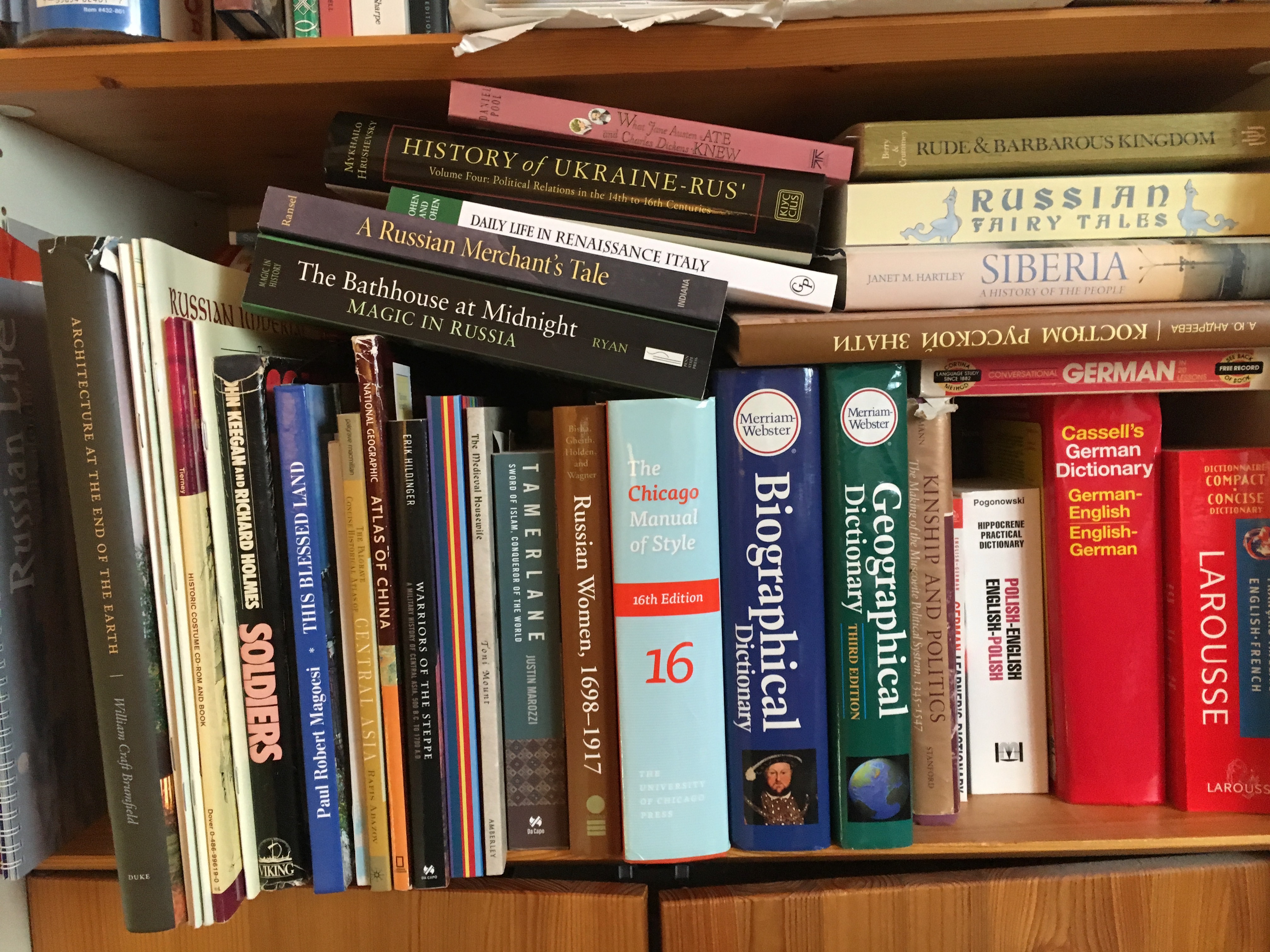
Images: Photograph of my overstuffed bookshelf © 2021 C. P. Lesley; cropped paintings by Konstantin Makovsky, The Tsar Chooses a Bride (1886) and Hans Holbein, The Ambassadors (1533)—my inspiration for the bride show in Song of the Storyteller and Felix in Song of the Siren, respectively—public domain via Wikimedia Commons.

Friday, September 16, 2022

Miss Marple Returns

Like many others, I have long been a fan of Agatha Christie—especially her creation of Miss Jane Marple. At one time or another, I have read all the Marple books, most of them more than once. So the idea of twelve new mysteries written by a collection of accomplished authors immediately appealed to me as both a reader and a novelist. But interviewing twelve authors posed a technical challenge. So the publicist and I came up with the idea of asking a single question and inviting authors to send their answers. Not everyone chose to participate, but at least half did. So here are some of the thoughts behind Marple: Twelve New Mysteries.

But first, the book summary.


One doesn’t stop at one murder...

Jane Marple is an elderly lady from St Mary Mead who possesses an uncanny knack for solving even the most perplexing puzzles. Now, for the first time in 45 years, Agatha Christie’s beloved character returns to the page for a globe-trotting tour of crime and detection.

Join Marple as she travels through her sleepy English village and around the world. In St Mary Mead, a Christmas dinner is interrupted by unexpected guests; the Broadway stage in New York City is set for a dangerous improvisation; bad omens surround an untimely death aboard a cruise ship to Hong Kong; and a bestselling writer on holiday in Italy is caught in a nefarious plot. These and other crimes committed in the name of love, jealousy, blackmail, and revenge are ones that only the indomitable Jane Marple can solve.

Bringing a fresh twist to the hallmarks of a classic Agatha Christie mystery, these twelve esteemed writers have captured the sharp wit, unique voice, and droll ingenuity of the deceptively demure detective. A triumphant celebration of Christie’s legacy and essential reading for crime lovers, Marple is a timely reminder why Jane Marple remains one of the most famous detectives of all time.

And now, the question—and the authors’ answers.

What inspired your particular story, and was it a challenge to blend your own voice with Agatha Christie’s?
 
Alyssa Cole: My story, “Miss Marple Takes Manhattan,” has her traveling to New York City to see a stage adaptation of one of her nephew Raymond’s novels. It was also inspired by the somewhat bittersweet undercurrent of the later Marple novels, where she is undergoing the mundane decline of being elderly, very much aware of it, but also still has what it takes to investigate and solve mysteries!

My story is an homage to the fact that Christie is the most successful female playwright ever; I figured if I was going to bring her to Manhattan, theater was a great backdrop to the mystery! It was challenging, but also fun! I focused on the aspects that stood out to me from Christie's writing—the humor, the subversiveness hidden by the presence of an elderly British woman, and the observational nature of Miss Marple. These were the aspects that I connected with most, and that I then tried to convey through my voice and writing style, but following her general lead.
 
Jean Kwok: I was inspired by Agatha Christie’s A Caribbean Mystery while writing my story, “The Jade Empress,” in which Miss Marple meets an elderly Chinese gentleman and his daughter on the deck of the Hong Kong–bound cruise ship The Jade Empress. The next morning, it is revealed that the gentleman has died of poisoning. Suspicion falls on his caretaker, a Chinese woman who performs all sorts of unusual rituals, but the daughter is certain that someone else must be to blame. When the caretaker’s body is discovered the next day, it’s up to Miss Marple to uncover the truth.
 
It was a challenge to attempt to channel Christie, of course, but it was also a true pleasure. I loved trying to hear Miss Marple in my mind. She has such a delightful, wry, and humorous voice. It also made me appreciate how brilliant Christie was at plotting, especially the ways in which she would ensure that the reader had all the clues they needed to solve the mystery without making anything too obvious.
 
Ruth Ware: I always felt aggrieved that while Poirot has not one but two Christmas stories, Miss Marple doesn't really have a proper one—just a rather sad murder that happens while she's Christmas shopping. I know that Christie loved Christmas—she wrote a long essay about her appreciation of a proper country Christmas—and I felt a little sad that Miss Marple never got to enjoy a real St Mary Mead Christmas in fiction, so I wanted to give her one!
 
Lucy Foley: My story was inspired by Sussex, the part of England I come from, and the rather pagan goings on that can still be found in several of the local villages and towns! I was certainly a little nervous about stepping into the great Agatha Christie’s shoes, but reading and rereading all of the Marple books and stories and really immersing myself in all things Marple helped hugely with getting the tone right and feeling confident writing about that world.

Kate Mosse: Although Christie’s Miss Marple appears in a handful of short stories, and then her first full length novel in 1930 (The Body in the Library), most of Jane Marple’s appearances happen in the time after the Second World War when life in England was changing quickly, and sometimes bewilderingly. Like many of my fellow contributors, I reread all of the Marple short stories and novels before starting to write, looking for biographical clues to Miss Marple’s life. Once I realized Jane Marple had an uncle who was a canon in Chichester Cathedral, the city where I grew up and live, I decided to set my story there in the years after the end of the war when the National Health Service had just come into being. “The Mystery of the Acid Soil” is a story of two older women, Jane Marple and her friend Emmeline Strickert, who discover a murder that no one else had even realized had taken place. The writing was a joy from start to finish, and I hope that the story will not only please die-hard Marple fans like myself, but also introduce a new generation of readers to the one and only Miss Marple.

And thank you to all the authors who participated in this Q&A. May you have many readers!