Pages

Friday, April 8, 2022

Interview with C.S. Harris

Fans of Sebastian St. Cyr, Viscount Devlin, will know that the individual tales that form his saga combine complex, fast-paced, often political mysteries with a series of revelations about his family’s history that it would be churlish to reveal in a post like this. All this takes place against the background of the Napoleonic Wars, mostly in Regency-era London with its vast social gap between the aristocratic rich and the starving, crime-ridden poor.

In When Blood Lies, the seventeenth installment, Sebastian’s encounter with his own past is particularly poignant. With Napoleon incarcerated on Elba and Europe at peace, Sebastian sees the perfect opportunity to seek out his long-lost mother (this information is itself a bit of a spoiler, but it’s included in the book’s short description), Sophia. So he travels to Paris in the hope of engineering a reconciliation with her or at least obtaining answers to his questions. He has no sooner established her whereabouts, however, than he stumbles over her body on the river bank near the Pont Neuf. She manages to say his name, proving that she recognizes him, then loses consciousness.

Sebastian has Sophia carried back to the home where he’s staying with his wife and children, only to watch his mother die before she can say anything more. In the interim, he discovers that she was murdered. He urges the local police force to find her killer, but with the Bourbons in charge of Paris, the police have little interest in tracking down the murderer of someone they consider a loose woman—and one associated with Napoleon, to boot. So Sebastian and his wife are on their own, determined to solve a murder that the local authorities refuse to acknowledge in a foreign city rife with political tension and rumors of Napoleon’s imminent return.


For reasons outside my control, I ended up reading this series out of order, which I do not recommend. Each book builds on the one before, and you will enjoy them most if you start with What Angels Fear and go from there. But even out of order, this is a remarkable story, not just engaging but engrossing, not to say impossible to put down. The murders themselves tend toward the gruesome (When Blood Lies is an exception in that regard), but you can skip over those parts and focus on the mystery or, if all else fails, Sebastian’s complex and constantly evolving interactions with the members of his immediate family.

Read on to learn more about the series and its main characters from the author herself.

This is Sebastian’s seventeenth adventure, although only four years have passed since we first met him in What Angels Fear. Before we get to him and what we can safely reveal about this story, where does the inspiration for the whole saga come from?

Because my PhD is in 18th- and 19th-century European history, I knew I wanted to set my mystery series in that period. My particular area of expertise—France in the Revolutionary and Napoleonic eras—struck me as just too depressing. So I thought, why not move across the Channel to Regency England? With Sebastian, I can explore the era’s social tensions, intellectual and creative developments, and political and military developments, but in a setting that isn’t as brutal or emotionally wrenching as, say, Paris in 1793. As for Sebastian’s personal saga, that just came to me over time as I lived with him, his family, and his friends in my head for a few years.

Sebastian himself is the central figure. Talk a little bit, please, about his somewhat unusual abilities and why you decided to assign them to your hero.

When Sebastian was still just an idea in my head, my daughter was a freshman biology student and volunteered to take an extensive DNA test for extra credit. They told her she had something called “Bithil Syndrome” (this came over the phone from an excited seventeen-year-old, so I could have the spelling wrong). It’s characterized by extremely keen hearing and eyesight, the ability to see well in the dark, and quick reflexes—all characteristics I’d noticed in her from the time she was little. So naturally I thought, What a cool syndrome to give a hero. I’ve been accused of making it up, but I didn’t; most people don’t realize there are thousands of rare syndromes that don’t come up in Google. (That daughter, BTW, is now a flight surgeon in the USAF.)

And what can you tell us about Sebastian himself? He’s been through some tumultuous times since that first novel.

When the series begins in early 1811, Sebastian is very damaged by the things he has seen and done in the war. For Sebastian, bringing justice to the victims of murder becomes a path to atonement. But at the same time as he is struggling to come to terms with his past, he must also deal with a series of truly shocking revelations about his mother, the man he thought was his father, and the woman he has long loved. So over the last four years of his life, he’s done a lot of growing and changing. It’s one of the things that helps keep it interesting for me as a writer and—I hope—for my readers.


Anyone who reads the book blurb for When Blood Lies will know that Sebastian is married by now. His wife, the former Hero Jarvis, is an interesting character in her own right. Tell us a bit about her background and her personality.

I really love Hero. I suspect in many ways she’s the woman I would like to be. She’s very tall (I’m really short) and has an enviable, unflappable sense of who she is. Her father, Jarvis, is Sebastian’s nemesis, so she sometimes finds herself caught between two people she loves. And she has more than a touch of her father’s ruthlessness in her, too, although she combines it with a sense of social responsibility and empathy he utterly lacks.

And what brings Hero and Sebastian to Paris in March 1815?

When the series begins, Sebastian thinks his mother is dead, that she was lost in a boating accident when he was 11. But by 1815 he knows the truth—that she ran off with a lover. Since that discovery he’s been looking for her, to ask her for the answers to some very important questions. Now that the war is over (or so everyone thinks) and their son is old enough to comfortably make the journey, he and Hero join the hordes of British aristocrats who at that time were flocking to Paris—which is where Sebastian has learned she’s now living with her lover, one of Napoleon’s generals.

The background to the whole series has been the Napoleonic Wars. At the beginning of this novel, Napoleon is in exile on Elba, but it’s not a spoiler to say he doesn’t stay there. How does his escape affect the atmosphere in Paris and your characters’ lives at this particular moment?

This aspect of When Blood Lies was intriguing to write. At first there are rumors that Napoleon is planning a return, but almost everyone expects him to fail spectacularly if he tries (these reactions are all historically accurate and taken from the letters, diplomatic dispatches, newspapers, and memoirs of the time). Then, once news of his escape reaches Paris, everyone still thinks it’s basically a joke, that he’ll quickly be stopped. They keep thinking this for days. So as Sebastian is frantically trying to figure out who killed his mother and why, Napoleon keeps getting closer and closer (remember, news traveled slow in those days), until people start to panic and everyone from the British ambassador’s wife (the Duchess of Wellington) to the recently restored Bourbon king frantically try to flee Paris. It’s human nature when the “unthinkable” starts to happen—whether it’s a pandemic spreading rapidly around the world or a sociopath making moves to take over a modern democracy—there is this tendency for people to think, “Oh, it can’t happen.” Except that it can and frequently does.


This novel just came out, but as we know, publishing takes a while. What are you working on now, and will there be an eighteenth Sebastian St. Cyr mystery?

I’m currently finishing writing the eighteenth Sebastian St. Cyr. I should have been done by now, but my house in New Orleans was wrecked by Hurricane Ida and I’ve spent the last six months repairing it, traveling back and forth between Louisiana and Texas, and moving into a new house in San Antonio. But the book will still be out in 2023, so no worries!

Thank you so much for answering my questions!
 

Candice Proctor, aka C.S. Harris and C.S. Graham, is the USA Today bestselling, award-winning author of more than two dozen novels, including the Sebastian St. Cyr Regency mystery series written under the name C.S. Harris, the C.S. Graham thriller series co-written with Steven Harris, and seven historical romances. She is also the author of a nonfiction historical study of women in the French Revolution. Find out more about her and her writing at https://csharris.net.

Images: Joseph Beaume, Napoleon Leaving Elba (1836); Fashion Plate, La Belle Assemblée (1814); Charles de Steuben, Napoleon’s Return from Elba (1818), all public domain via Wikimedia Commons.

Friday, April 1, 2022

Long Live the King?


The French Revolution is not at present quite the publishing powerhouse it has sometimes been, but it still draws a good deal of attention. It’s such a dramatic setting, so it’s no wonder that many novelists succumb to the lure. I myself set The Not Exactly Scarlet Pimpernel there—or at least in a virtual version of there—before turning my focus to sixteenth-century Russia and the steppe.

Eva Stachniak’s The School of Mirrors ends with the Terror, but it opens in Paris a good forty years before the forces of reform become radicalized, in the wildly extravagant court of Louis XV (r. 1715–1774). The king, approaching forty, has an official mistress, Madame de Pompadour, who no longer wants a physical relationship. She does, however, want to ensure that no one who replaces her in the king’s bed can threaten her position as the main power behind the throne. So she endorses a scheme to lure innocent girls, no older than thirteen or fourteen, out of poverty and into a school that will train them to sate the king’s appetites
.

As Eva Stachniak explains during our New Books Network interview, her heroine Véronique has a real antecedent, although this story is fiction. And as in real life, the heroine’s brief relationship with the king has consequences that both spool out into history and reveal the callousness and excess that lit the flames of revolution.

The rest of this post comes from New Books in Historical Fiction.

France in 1755 is a country of extremes. The streets of Paris are filled with the poor and downtrodden, whereas just a few miles away lies the Palace of Versailles, with its renowned Hall of Mirrors where courtiers under the eye of Louis XV while away the hours amid endless extravagance. Once known as Louis the Beloved, the king has steadily lost ground with his people, and even his long-term relationship with Madame de Pompadour has entered a new phase. To retain her power and appeal to the king’s changing appetites, Madame enlists the help of Dominic-Guillaume Lebel, Louis’s valet de chambre. He sets up a school in Deer Park (Parc-aux-Cerfs), near the palace, where carefully selected thirteen- and fourteen-year-old girls from poor families can master basic literacy, painting, music, dance, embroidery, manners, and court protocol. Those who succeed in pleasing the king leave with a dowry and an income for life. Even those who fail receive some kind of financial settlement.

Véronique Roux, a printer’s daughter fallen on hard times, enters the school and does well—until a chance remark leads to her hasty dismissal. Years later, a little girl named Marie-Louise—who, as we know from the book jacket, is Véronique’s daughter, sired by the king and wrenched from her mother at birth—is summoned to Versailles and turned over to two of Madame de Pompadour’s servants for her education. Marie-Louise wants nothing more than to find the parents who abandoned her, without knowing who they are, and through her story we see the connections of Louis XV’s failures as a ruler and how they lead to the French Revolution in 1789.

Eva Stachniak takes the element of the real-life school at Deer Park and builds it, through the fictional characters of Véronique and Marie-Louise, into a powerful indictment of both a monarchy in decline and the radicals who sought to overthrow it at all costs, even when their initial idealism caused them to turn against one another.


Images: Hyacinthe Rigaud, Louis XV (1730); François Boucher, Madame de Pompadour (1756); and Jean-Pierre Houël, The Storming of the Bastille (1789), all public domain via Wikimedia Commons.

Friday, March 25, 2022

Interview with Andrea Penrose

As I’ve mentioned elsewhere, I discovered Andrea Penrose’s Wrexford & Sloane series of Regency mysteries by accident, through an Amazon recommendation. I read them all and had the chance to interview her for the New Books Network when the latest, Murder at the Royal Botanic Gardens, came out with Kensington Books last fall.

Somewhere along the way, I discovered that she had written a second series—also set during the Regency and featuring an earl, Lord Saybrook, and his initial adversary, later wife, Lady Arianna Hadley. The combination of Russians and chocolate persuaded me to give Lady Arianna a try, and soon I had polished off that series too. And now, to celebrate the release of Lady Arianna no. 7, A Swirl of Shadows, the author herself is here to answer my questions. I’m delighted to welcome her.

What was your inspiration for this series?

The Regency era in and of itself was a core inspiration. I love the time period because it was a fabulously interesting time and place—a world aswirl in silks, seduction, and the intrigue of the Napoleonic Wars. Radical new ideas were clashing with the conventional thinking of the past. People were questioning the fundamentals of society, and as a result they were fomenting changes in every aspect of life. Politics, art, music, science, social rules—the world was turning upside down, especially as women were really beginning to challenge the boundaries of their traditional roles in society.

I really like writing about people who are both strong and vulnerable. We all have strengths and weaknesses, and how we learn to balance those conflicting elements is, to me, an integral part of the human experience. An author can, of course, play with those tensions in any era, but for me the Regency presents a particularly interesting time in which to do so with an unconventional heroine.

Lady Arianna Hadley is a fascinating character. She develops over the course of the series, but tell us what you’d like readers to know about her going in.

Arianna has a gritty backstory, and in the first book she has come to England to seek revenge. Strong, clever and resourceful, she’s had to look out for herself for most of her life, and so trust doesn’t come easily for her. But she has a strong moral compass and a passion for justice, having had personal experience with injustices. That makes her an excellent sleuth.

Her initial interactions with the Earl of Saybrook are, shall we say, more confrontational than collegial. What can you tell us about him, and why don’t they get along at first?

Like Arianna, Saybrook is a complicated person. A titled aristocrat, a former military intelligence officer, and a brilliant botanist, he’s an outsider in the beau monde because his mother was a foreigner. When readers first meet him, he’s recovering from a serious war wound in London and is asked by the government to investigate the poisoning of the Prince Regent at a fancy supper party—where, disguised as a male chef, Arianna did the cooking. During their first encounter, their verbal fencing takes a sharper edge, but circumstances force them to become reluctant allies to find the real culprit, which leads them to uncover an even more sinister plot … and develop a a grudging friendship.


I have to admit that what first drew me to these books was the combination of Russians and chocolate, more specifically cacao. We’ll get to the Russians in a minute, but what made you want to include the chocolate?

In a sense, it happened by accident! For a very different project, I had stumbled across the fascinating fact there there was edible chocolate in the Georgian/Regency era. (The common perception is it was invented in 1847.) Sulpice Debauve, the personal physician to Marie Antoinette, concocted disks of flavored chocolate and spiked them with her medicines because otherwise she refused to take them. To make a long story short, he went on to open a chocolate shop in Paris in 1800. (You can read a long history of chocolate on my website under the “Diversions” tab.)

My agent loved the chocolate info and suggested we send out a proposal for a “chocolate mystery” set in the Regency. I pondered the idea, saw some really interesting possibilities, and came up with Arianna—who wasn’t at all the heroine that my agent expected! She had envisioned a cozy mystery series revolving around the proprietor of a chocolate shop who gets involved in solving mysteries in her town. I had different ideas. I wanted to write an edgier type of series that dealt with both the glittering ballrooms of London and the dark side of the beau monde, where the misuse of power and privilege was rampant.

As I said, my agent was surprised—but she really liked the sample chapters I did, and we sold it to Penguin Putnam. The line ended up being reorganized, and they didn’t offer to continue the series. But I loved writing it so much that I decided to continue the stories as a self-published series.

The overall background to these novels is the political negotiations—and machinations—surrounding the end of the Napoleonic Wars. By the time we get to A Swirl of Shadows, Arianna and Saybrook are being encouraged to travel to St. Petersburg. Why? And what do they find when they get there?

Tsar Alexander was a really interesting and important figure in the Regency era. Handsome and charming, he was also mercurial and enigmatic. He was a key leader in defeating Napoleon, but his own personal weaknesses made him vulnerable to intrigue and schemers. Actual history records that he did fall under the spell of a woman mystic and that her influence threatened his reign. In A Swirl of Shadows, the British government asks Arianna and Saybrook—who know Alexander from a previous mystery in Vienna—to journey to St. Petersburg to stop an American adventuress from orchestrating a clever plot that will topple the tsar from his throne and threaten Europe’s new-found peace.

However, when they arrive, they find things aren’t at all what they seem, and with the Imperial Court a viper’s nest of intrigue and betrayals, Arianna and Saybrook must cobble together a band of unexpected allies in order to beat the devil at his own game.

The person doing the encouraging, not to say arm-twisting, is Lord Grentham, who has been present from the beginning of the series. Give us a capsule description of him, please.

Grentham has been a really interesting character to develop. As Britain’s top spymaster, he’s ruthlessly cold and pragmatic, and I intended him to be a foil for Arianna and Saybrook’s more finely honed sense of fair play and justice. But it turns out he had other ideas about that and is a far more nuanced character. It’s funny how that can happen to an author! 


I can’t let you go without asking about Arianna’s friend Sophia. Who is she, and why does she decide to accompany them to St. Petersburg?

Sophia also has hidden facets. She and Arianna are very different personalities, shaped by the fact that they both had have painful experiences in the past. At first, they are wary of each other, but as often happens in real life, seemingly mismatched people can develop a very interesting friendship.

With Sophia, I have enjoyed playing with taking a person’s core vulnerability and turning it into a strength. Sophia demands to accompany Arianna and Saybrook to St. Petersburg because she feels that her particular expertise will be invaluable to them. There are also very personal reasons involved, but I shall leave them for readers to discover!

This novel just came out. What are you working on now, and can we look forward to another Lady Arianna adventure?

I’m currently working on a new Wrexford & Sloane mystery, which is also set in the Regency era. There’s also another possible project percolating, but for now it’s just in the “thinking” stage. We’ll see where it goes. As for Arianna, I am in the first stages of sketching out a new plot for her and Saybrook. So stay tuned!

Thank you so much for answering my questions!

Andrea Penrose is the bestselling author of Regency-era historical fiction, including the acclaimed Wrexford & Sloane mystery series. Find out more about her at https://andreapenrose.com.

Images: Thomas Lawrence, Alexander I (1814–1818), and Efim Tukharinov, The Rotunda (of the Winter Palace, 1834) both public domain; photograph of cacao pods © Tamorlan, own work, CC BY 3.0—all via Wikimedia Commons.


Friday, March 18, 2022

Mad Kings and Murderers

Reading historical mysteries has many benefits beyond the pure fun of solving an intellectual puzzle: who, among many possible suspects with means and motive, actually killed the victim? And yes, it sounds odd to use the term “intellectual” in reference to something as emotionally fraught and socially disruptive as murder, but that’s the point of reading a novel rather than living an experience in real time. Real-life killings evoke a whole range of responses—rage, grief, terror. A victim in a book is just a body; at best, we learn enough about the character to feel sorrow for that person’s passing, to appreciate the mourning of those left behind. The detective, amateur or professional, focuses on the suspects, and therefore so do we.

In a historical setting, though, we also—if the author has paid due attention to the differences between present and past—get a sense of changing times and attitudes. Is a death attributed to sorcery or demonic possession? Does the killer,  in the views of those involved, express innate evil or human frailty? Was the murder “justified” because the victim violated society’s laws? Or is the killer the one whose defiance of the rules demands the imposition of extreme penalties?

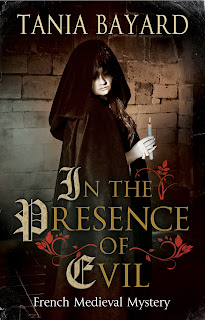
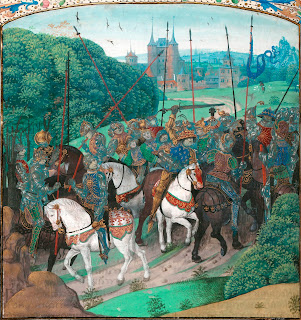
Tania Bayard explores these questions and more in her Christine de Pizan novels, the subject of my latest New Books Network interview. Set in fourteenth-century France, often at the royal court in Paris, the murders take place in and reflect the concerns of a medieval world taking its first steps toward the Renaissance. The king—Charles VI, known as “the Mad” ever since his attack on his own men in the midst of battle—suffers from a series of psychotic episodes that most of the populace attributes to witchcraft and sorcery. Constant in-fighting between the queen, the regent, and various relatives who would like to replace the regent fuels the general sense of fear and uncertainty.

Even without that immediate context, the lingering results of past decisions by the king, ongoing hostilities with neighboring lands, changing views of women (stridently opposed by many in the Church and the universities), endemic poverty and disease, and the increasing power of merchants in a society still ruled by warrior aristocrats play into views of justice and mercy and sin that govern people’s reactions to sudden, unexplained death.

And in a strange way, we can see our own pandemic-tinged world, with its ongoing war between superstition and science, dimly reflected in Bayard’s vividly realized medieval kingdom and refracted through the persona of her fictionalized heroine—the poet, scribe, philosopher, and defender of women’s right to be considered fully human and capable Christine de Pizan (1364–c. 1430).


As usual, the rest of this post comes from New Books in Historical Fiction. The interview is also featured on LitHub.

There is a great temptation, when writing about the past, to sanitize its circumstances and attitudes to make the characters more palatable to present-day readers. Tania Bayard, who has written four mystery novels set in fourteenth-century France, does not make that mistake. Her Paris is filthy and smelly, with muddy streets and refuse lying in heaps, horrible diseases, stray dogs, and dead rats in the gutters. Her characters, too, wallow in prejudices and superstitions of all sorts. And those streets are filled with beggars, prostitutes, thieves, cheats, and would-be sorcerers and witches, ready to prey on upstanding citizens.

Yet fourteenth-century France, in these novels as in real life, also contains farsighted thinkers, gifted artists of all sorts, and would-be scientists. One of the shining lights is Christine de Pizan, a scribe at the court of Charles VI “the Mad” who will soon establish a name for herself as a poet and early feminist. Contrary to the stereotypes of medieval women as passive and obedient, Christine works hard to support her family and resolutely challenges the prejudices of the men around her, especially her frequent bête noire and sometime supporter, Henri Le Picart. 

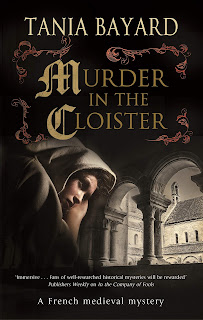
In Murder in the Cloister, the sudden death of a young nun causes the prioress to summon Christine, who has already solved three crimes affecting the royal family, to find out what happened. On the surface, Christine has been hired to copy an important manuscript, but her investigations turn up not only secrets and lies but ongoing sources of tension among the nuns. And even as she races to untangle the mystery before more deaths occur, she must counteract Henri’s efforts to protect—or is it undermine?—her and what she fears is his undesirable influence on her young son.

Bayard has taken some flak for her decision to adopt a historical person as her fictional detective, but as she notes during this interview, any character she could have invented would have been less complex and less credible than Christine, who defied both her own society’s expectations and our own limited view of medieval women. So relax, don’t worry too much about the details of the crimes being fictional, and enjoy parachuting into a fully imagined past that you can hope never to experience in real life.

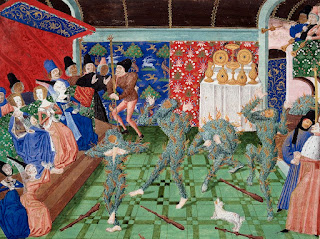
Images: Charles VI attacking his own men and of Le Bal des Ardents (The Ball of Burning Men), from a 14th-century book of hours, public domain via Wikimedia Commons.

Friday, March 11, 2022

Mysteries Past and Present

Donnell Ann Bell was nice enough to post this comparison of mysteries set in the present versus the past on her blog last week. But once you’re done reading it here, do check out her other posts—and her books, if you like contemporary suspense novels—as well.

Imagine the following scenario: two sisters decide to leave the big city to spend the summer at their second home. They travel with several children and assorted family members. Along the way, someone attempts to ambush them, then flees before they can ascertain whether the objective was robbery or murder. The sisters don’t recognize the attackers and therefore can’t be sure why they’ve been targeted, although they do have an enemy and suspect him of giving the orders.


So far, we could be looking at an incident from any novel with elements of mystery or suspense. But what happens next depends greatly on when and where the attack takes place. In the modern world, the sisters would call the police from a cellphone, probably even while the assault was underway—unleashing the full panoply of sirens, all points bulletins, computer searches, DNA tests, and police raids. The search might not lead to an arrest in real life, but in a novel readers would experience a dramatic, high-tension chase as the investigation proceeds to its logical conclusion.

As it happens, though, these sisters live in sixteenth-century Russia. They have no police to call and no phones with which to summon them. There are bailiffs who make arrests, but who bears responsibility for supervising a particular stretch of road remains unclear. The local authorities have never heard of fingerprinting, never mind genetic testing or computerized records. And the robbers, having escaped, can vanish into the vast, uncharted countryside and return to fight another day.


Therein lies the drama, from the perspective of a historical novelist.  The technological advances that drive a modern detective or suspense novel certainly have their advantages, especially in real life, but from a fictional standpoint at times they make cases almost too easy to solve. Against such detailed information, imagine the possibilities offered by the past, where characters can plausibly flee into the woods and set themselves up as bandit chieftains, disappear for months on end without communicating by e-mail or texting or even through letters, misrepresent themselves as scions of noble or royal houses without being detected, or break into a home or an office without leaving a trace that anyone investigating the crime can detect.

It would be hard to pull off any of these plot points now, yet I’ve used some version of them all in my Legends of the Five Directions and Songs of Steppe & Forest novels. The incident described in my opening paragraph comes from my latest novel, Song of the Sinner, and involves the heroine of that book, Solomonida, and her younger sister Darya, who have left Moscow in the hope of escaping the attention of their bullying cousin Igor, intent on grabbing their property and in general making them pay for daring to thwart his plans for marrying them off, whatever they think of his choices. Like the trip to the country, Igor’s motivation is timeless: he wants to benefit himself, no matter the cost to others.


But the means he uses to attain his goals are not those of the modern world, and the counter-measures adopted by Solomonida and Darya are different, too. The attempted ambush fails because they travel with an armed escort, a normal precaution taken by aristocrats at the time, and the escort remains with them to guard their estate against these or any other criminally minded sorts. Igor doesn’t have to worry about surveillance cameras and drones, and his rank protects him even when he’s fingered in a later assault on the hero. But his own inability to read trips him up time after time, as does his tendency to discount potential opposition from women and members of the lower classes, a category that in his mind includes even the highest-ranking civil servants—men (and yes, in those days they were all men) who in our own time would head corporations, excel in the law courts, or resolve international crises.


So if you are writing a story where the only means of stopping your villain is to use the latest bells and whistles, a contemporary saga is the way to go. But if you really want to push your protagonists to the limits, consider taking a time machine into the past. You may be surprised by the vistas that suddenly open up before you.


Images from Pixabay, no attribution required.